


In today’s digital workplace, employees rely on technology to complete nearly every task-from accessing cloud applications and collaborating with colleagues to communicating with customers and managing critical business operations. When technology fails, even a minor issue can disrupt workflows, reduce productivity, and impact overall business performance.
Many organizations still depend on traditional help desks that focus primarily on resolving IT problems after they occur. While this reactive approach may address immediate issues, it often results in longer response times, recurring technical problems, and frustrated employees.
Modern Service Desk Support has transformed the way businesses manage IT services. Rather than simply fixing technical issues, Modern Service Desk Support takes a proactive approach by monitoring systems, automating routine tasks, providing self-service options, and ensuring employees receive timely assistance whenever they need it.
A modern service desk is more than an IT support function-it acts as a strategic business partner that helps employees stay productive, minimizes downtime, and enhances the overall digital workplace experience. By providing reliable Modern Service Desk Support, organizations can reduce technology-related disruptions and help employees focus on their core responsibilities.
In this article, we’ll explore how Modern Service Desk Support improves employee productivity, the key features of an effective service desk, and why businesses are investing in modern IT support solutions in 2026.
What Is Modern Service Desk Support?
A Modern Service Desk is a centralized IT support function that manages incidents, service requests, technical issues, user access, and IT services across an organization.
Unlike traditional help desks that mainly react to technical problems, modern service desks focus on delivering a proactive and user-centric experience. They leverage automation, artificial intelligence (AI), IT Service Management (ITSM) frameworks, and real-time monitoring to resolve issues quickly while preventing future disruptions.
Modern Service Desk Support typically includes:
- Incident Management
- Service Request Management
- Problem Management
- Change Management
- Knowledge Management
- Remote IT Support
- User Access Management
- Asset Management
- Self-Service Portals
- Performance Monitoring
By combining technology, standardized processes, and skilled support professionals, organizations can ensure employees receive consistent and efficient IT assistance.
Why Employee Productivity Depends on IT Support
Technology interruptions can have a significant impact on daily operations. A slow laptop, network outage, application error, or forgotten password may seem like a small issue, but when multiplied across an organization, these problems can lead to hundreds of lost working hours every month.

Common workplace IT challenges include:
- Slow business applications
- Login and authentication issues
- Email problems
- Network connectivity failures
- Printer and hardware issues
- Software installation delays
- Cloud application access issues
- Collaboration platform disruptions
Without an efficient Service Desk, employees spend valuable time waiting for support instead of focusing on their core responsibilities.
Modern IT support minimizes these disruptions through proactive monitoring, faster response times, and continuous service improvements.
1. Faster Issue Resolution Minimizes Downtime
One of the biggest advantages of a modern service desk is its ability to resolve IT issues quickly.
Traditional support models often rely on manual ticket handling, delayed escalations, and reactive troubleshooting. This results in longer wait times and increased employee frustration.
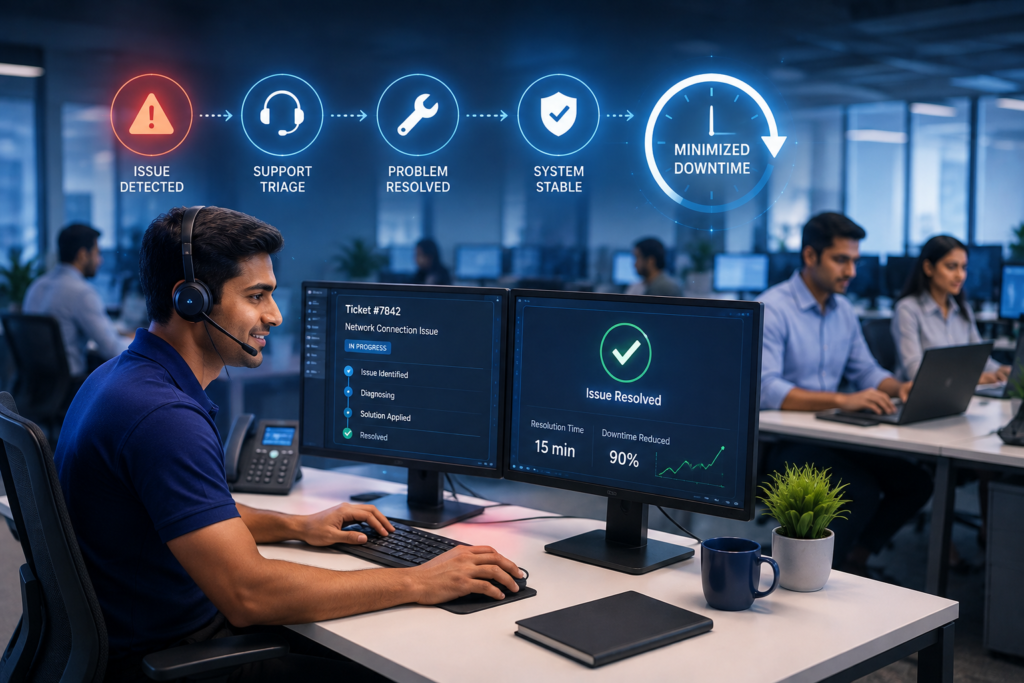
Modern service desks use:
- Intelligent ticket routing
- Automated workflows
- AI-powered recommendations
- Knowledge base integration
- Real-time monitoring
These capabilities enable support teams to identify issues faster, assign them to the right specialists, and resolve them efficiently.
For employees, this means less downtime and more time spent on productive work.
2. Proactive Monitoring Prevents Problems Before They Occur
Instead of waiting for employees to report issues, modern service desks continuously monitor IT infrastructure, applications, and devices.
Proactive monitoring helps detect:
- Server performance issues
- Storage capacity limits
- Network congestion
- Application failures
- Security alerts
- Hardware health issues
By identifying potential problems early, IT teams can resolve them before they disrupt business operations.
This proactive approach significantly improves employee productivity because technical issues are often addressed before users even notice them.
Organizations implementing proactive monitoring often combine it with Managed IT Services to ensure continuous infrastructure optimization.
3. Self-Service Portals Empower Employees
Modern employees expect quick access to information and services.
Rather than contacting IT support for every request, organizations are implementing self-service portals where employees can:
- Reset passwords
- Submit service requests
- Track support tickets
- Access software downloads
- Find troubleshooting guides
- Request hardware
- View IT announcements
Self-service capabilities reduce support workloads while allowing employees to solve common problems independently.
This improves response times and increases overall workplace efficiency.
4. Automation Eliminates Repetitive Tasks
Automation is transforming service desk operations by reducing manual effort and improving consistency.
Modern service desks automate tasks such as:
- Password resets
- User provisioning
- Software installations
- Ticket categorization
- Approval workflows
- Incident notifications
- Asset tracking
By automating routine activities, IT professionals can focus on strategic initiatives while employees receive faster service.
Automation also minimizes human errors and ensures standardized service delivery across the organization.
5. Better Knowledge Management Improves First-Contact Resolution
One of the defining characteristics of a modern service desk is a centralized knowledge management system.
Knowledge bases contain:
- Troubleshooting guides
- Frequently asked questions
- Standard operating procedures
- Technical documentation
- Best practices
- Configuration instructions
Support agents can quickly access relevant information while resolving incidents, reducing the time required to diagnose and fix issues.
Knowledge management also enables employees to find answers independently, further reducing support requests.
Organizations exploring AI-powered knowledge management should read our guide on How to Build a RAG Knowledge Base for Your Enterprise, which explains how intelligent search improves IT support and organizational productivity.
6. Personalized IT Support Enhances the Employee Experience
Employees expect fast, personalized, and hassle-free IT support. A modern service desk goes beyond resolving technical issues by delivering a user-centric support experience.
With integrated IT Service Management (ITSM) platforms, support teams can access an employee’s support history, assigned devices, software licenses, and previous incidents. This context enables faster and more accurate issue resolution.
Personalized support offers several benefits:
- Faster response times
- Reduced ticket repetition
- Tailored solutions based on user roles
- Improved communication throughout the support process
- Higher employee satisfaction
When employees receive efficient support without repeatedly explaining their issues, they can return to work more quickly, improving productivity across the organization.
7. Supporting Hybrid and Remote Workforces
The modern workplace extends far beyond the office. Employees now work from homes, client locations, and satellite offices, making reliable IT support essential regardless of location.

A modern service desk enables remote teams through:
- Secure remote troubleshooting
- Virtual desktop support
- VPN assistance
- Cloud application support
- Mobile device management
- Collaboration platform support
- Multi-channel communication (phone, email, chat, and portals)
Remote support minimizes interruptions and ensures employees stay connected wherever they work.
Organizations adopting cloud-first strategies can further improve workforce flexibility through secure cloud infrastructure. Learn more about our Cloud Migration Services.
8. Stronger Cybersecurity Through Service Desk Operations
Cybersecurity is no longer the sole responsibility of the security team. Modern service desks play an important role in protecting business systems and employee devices.
Service desk teams help organizations by:
- Managing user access requests
- Enforcing password policies
- Applying security patches
- Detecting unusual system activity
- Managing endpoint security
- Responding to security incidents
- Supporting compliance requirements
Employees also benefit from quick assistance when reporting phishing emails, suspicious activity, or compromised devices.
A proactive service desk helps reduce security risks while ensuring business continuity.
9. Data-Driven Decision Making with ITSM Analytics
Modern service desks don’t just resolve tickets-they generate valuable operational insights.
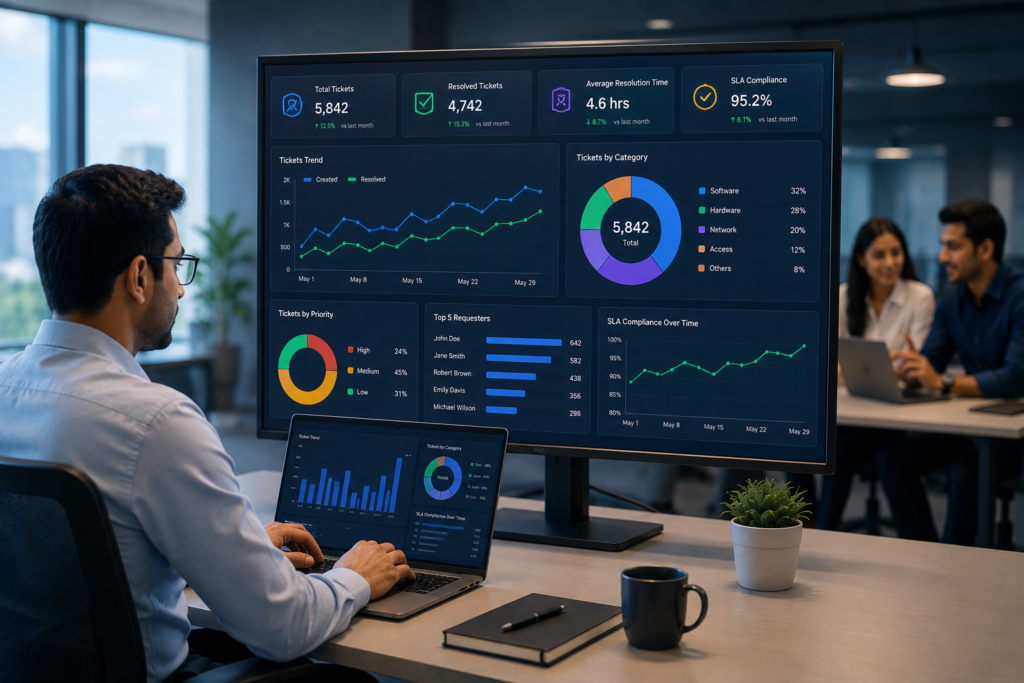
ITSM analytics provide real-time visibility into:
- Ticket volumes
- Resolution times
- Recurring incidents
- Employee satisfaction
- Service level agreement (SLA) performance
- System availability
- Asset utilization
These insights help IT leaders identify recurring problems, improve service quality, allocate resources more effectively, and make informed technology decisions.
By analyzing trends, organizations can proactively eliminate bottlenecks instead of repeatedly fixing the same issues.
10. Continuous Improvement Through Automation and AI
Artificial Intelligence (AI) and automation are transforming modern service desk operations.
Today’s service desks use AI to:
- Automatically categorize support tickets
- Recommend solutions based on previous incidents
- Predict recurring problems
- Automate repetitive support tasks
- Route tickets to the appropriate specialists
- Power virtual assistants and chatbots
Automation reduces response times while allowing IT teams to focus on strategic projects instead of routine support activities.
Modern Service Desk vs. Traditional Help Desk
Although these terms are often used interchangeably, they serve different purposes.
| Feature | Traditional Help Desk | Modern Service Desk |
| Approach | Reactive | Proactive |
| Focus | Fixing issues | Managing IT services |
| Automation | Limited | Extensive |
| Self-Service Portal | Rare | Standard |
| Knowledge Management | Basic | Advanced |
| AI Integration | Minimal | Common |
| Performance Analytics | Limited | Comprehensive |
| Continuous Improvement | Reactive | Ongoing |
| Employee Experience | Secondary | Primary Focus |
A traditional help desk solves technical problems, while a modern service desk continuously improves IT services to support business objectives and employee productivity.
Best Practices for Implementing a Modern Service Desk
To maximize the benefits of service desk support, organizations should adopt a structured approach.
Standardize IT Processes
Implement IT Service Management (ITSM) best practices for incident, problem, change, and asset management.
Invest in Knowledge Management
Maintain an up-to-date knowledge base that enables both employees and support agents to resolve common issues quickly.
Automate Routine Tasks
Automate repetitive processes such as password resets, software requests, and ticket routing to improve efficiency.
Monitor Service Performance
Track KPIs such as:
- First Response Time
- Resolution Time
- SLA Compliance
- Customer Satisfaction (CSAT)
- First Contact Resolution Rate
Regular performance reviews help identify opportunities for continuous improvement.
Focus on Employee Experience
A successful service desk prioritizes communication, responsiveness, and user satisfaction alongside technical performance.
How ParamInfo Helps Businesses Improve IT Support
Modern organizations require more than reactive technical assistance-they need proactive, scalable, and business-focused IT support.
At ParamInfo, we help organizations build modern service desk environments that improve operational efficiency, enhance employee productivity, and support long-term digital transformation.
Our capabilities include:
- IT Service Desk Support
- Managed IT Services
- Incident & Problem Management
- Application Support & Maintenance
- Infrastructure Monitoring
- Cloud Support Services
- End-User Computing Support
- IT Asset Management
- Performance Monitoring
- Service Level Management
By combining experienced professionals, modern ITSM practices, automation, and proactive monitoring, we help businesses reduce downtime, improve employee experiences, and optimize technology investments.
Technology plays a vital role in employee productivity, but even the best digital tools lose value when technical issues disrupt daily work. Modern Service Desk Support helps organizations move beyond reactive problem-solving by delivering proactive support, intelligent automation, self-service capabilities, and data-driven service improvements.
From resolving incidents faster and supporting hybrid work to strengthening cybersecurity and enhancing employee experiences, Modern Service Desk Support enables organizations to maintain business continuity while empowering employees to perform at their best.
As businesses continue their digital transformation journey in 2026, investing in Modern Service Desk Support is no longer just an IT decision-it is a strategic investment in productivity, operational efficiency, and long-term business success.
Partnering with an experienced technology provider like ParamInfo ensures your organization benefits from reliable IT support, industry best practices, and scalable Modern Service Desk Support solutions designed to meet evolving business needs.
Frequently Asked Questions (FAQs)
1. What is a modern service desk?
A modern service desk is a centralized IT support function that proactively manages incidents, service requests, user support, and IT services using automation, AI, and ITSM best practices.
2. How does a service desk improve employee productivity?
It reduces downtime by resolving technical issues quickly, providing self-service options, automating routine tasks, and ensuring employees receive timely IT support.
3. What is the difference between a help desk and a service desk?
A help desk focuses on resolving technical issues, while a service desk manages the complete lifecycle of IT services, emphasizing continuous improvement and business alignment.
4. What services does a modern service desk provide?
Typical services include incident management, request fulfillment, change management, asset management, user access management, remote support, and knowledge management.
5. Why is proactive IT support important?
Proactive support identifies and resolves potential issues before they impact employees, reducing downtime and improving operational efficiency.
6. Can a modern service desk support remote employees?
Yes. Modern service desks provide remote troubleshooting, cloud application support, VPN assistance, and multi-channel communication for hybrid and remote teams.
7. How does automation improve service desk operations?
Automation speeds up ticket routing, password resets, software deployment, approvals, and routine tasks, allowing support teams to focus on complex issues.
8. What role does AI play in modern service desks?
AI helps classify tickets, recommend solutions, predict incidents, automate workflows, and improve response times through virtual assistants and intelligent analytics.
9. What are the key metrics for measuring service desk performance?
Important metrics include First Response Time, Resolution Time, SLA Compliance, First Contact Resolution, Ticket Volume, and Customer Satisfaction (CSAT).
10. Why should businesses invest in modern service desk support?
A modern service desk improves employee productivity, enhances user experiences, strengthens security, reduces downtime, and supports digital transformation initiatives.
11. Which industries benefit from modern service desk services?
Healthcare, banking, retail, manufacturing, education, government, logistics, and technology organizations all benefit from efficient IT service desk support.
12. How can ParamInfo help improve IT service desk operations?
ParamInfo delivers modern IT Service Desk Support, Managed IT Services, infrastructure monitoring, application support, and cloud services to help businesses improve productivity and optimize IT operations.
