

Business applications have become the backbone of modern organizations. From enterprise resource planning (ERP) and customer relationship management (CRM) platforms to e-commerce systems and mobile applications, businesses depend on software to manage operations, serve customers, and drive growth.
However, deploying an application is only the beginning of its lifecycle. Over time, software requires continuous monitoring, updates, performance optimization, bug fixes, security patches, and compatibility improvements to remain reliable and efficient. Without ongoing maintenance, even the most well-designed applications can become slow, vulnerable to cyber threats, and costly to maintain.
Many organizations delay investing in Application Support and Maintenance Services, assuming that applications only need attention when something goes wrong. In reality, a reactive approach often results in unexpected downtime, poor user experiences, higher operational costs, and security risks.
Application Support and Maintenance Services take a proactive approach by ensuring your business applications remain secure, up to date, scalable, and optimized for performance. These services include preventive maintenance, issue resolution, system monitoring, version upgrades, performance tuning, and technical support, allowing businesses to focus on innovation instead of troubleshooting.
In this article, we’ll explore 15 warning signs that indicate your business needs professional Application Support and Maintenance Services and explain how proactive maintenance can improve business continuity, application performance, and long-term return on investment.
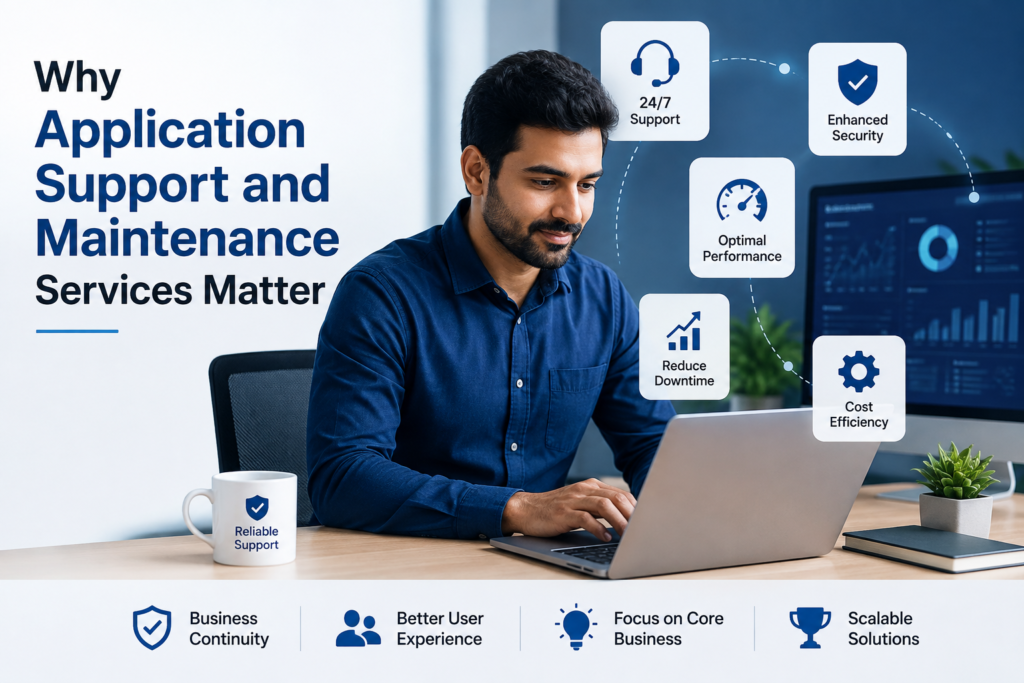
Why Application Support and Maintenance Services Matter
Business applications are expected to operate 24/7 with minimal interruptions. Customers expect seamless digital experiences; employees rely on software for daily operations, and management depends on accurate business data to make informed decisions.
Without regular maintenance, applications can experience:
- Frequent system crashes
- Performance bottlenecks
- Security vulnerabilities
- Data inconsistencies
- Compatibility issues
- Higher maintenance costs
- Reduced user satisfaction
Professional Application Support Services help organizations prevent these issues through continuous monitoring, timely updates, proactive troubleshooting, and performance optimization.
Warning Sign #1: Your Application Frequently Crashes
One of the clearest indicators that your application requires professional support is recurring downtime.
Unexpected application crashes interrupt daily business operations, delay customer transactions, reduce employee productivity, and negatively impact your brand reputation.
Common causes include:
- Memory leaks
- Database failures
- Server overload
- Poor coding practices
- Infrastructure issues
- Outdated software components
Application Support teams continuously monitor application health to identify root causes before they result in business disruptions.
Warning Sign #2: Slow Application Performance
Application speed directly influences customer satisfaction and employee productivity.
If users regularly experience:
- Slow loading pages
- Delayed transactions
- Long login times
- Slow report generation
- Lagging dashboards
Your software requires performance optimization.
Professional maintenance teams improve performance by:
- Optimizing databases
- Monitoring server utilization
- Improving application architecture
- Reducing unnecessary processes
- Optimizing APIs
A faster application improves customer experience while increasing employee efficiency.
Warning Sign #3: Security Vulnerabilities Are Increasing
Cybersecurity threats continue to evolve rapidly.
Applications running outdated libraries, unsupported frameworks, or delayed security patches become attractive targets for cybercriminals.
Potential risks include:
- Data breaches
- Ransomware attacks
- SQL injection
- Cross-site scripting (XSS)
- Unauthorized access
- Malware infections
Application Maintenance Services ensure:
- Security patches are applied promptly
- Vulnerabilities are identified proactively
- Access controls remain secure
- Compliance requirements are maintained
Organizations adopting secure cloud environments should also review our Cloud Migration Checklist for UAE Businesses in 2026, which highlights security best practices during modernization.
Warning Sign #4: Your IT Team Spends Too Much Time Fixing Issues
If your internal IT team constantly responds to software incidents instead of focusing on innovation, it’s a strong indication that your applications need dedicated support.
Instead of driving digital transformation, your technical teams may spend their time:
- Resolving user complaints
- Restarting servers
- Fixing recurring bugs
- Recovering failed transactions
- Investigating system failures
Outsourcing application support allows internal teams to focus on strategic initiatives while experienced specialists handle routine maintenance and issue resolution.
Warning Sign #5: Software Updates Are Frequently Delayed
Modern business applications rely on continuous updates to improve functionality, maintain compatibility, and address security vulnerabilities.
Delaying updates increases the risk of:
- Security breaches
- Performance degradation
- Compatibility issues
- Compliance failures
- Unsupported software
Application Support Services ensure regular maintenance schedules, version upgrades, and testing before deployment, reducing operational risks.
Warning Sign #6: Customer Complaints Are Increasing
Customers quickly notice application issues.
Common complaints include:
- Slow websites
- Failed transactions
- Login problems
- Mobile app crashes
- Payment failures
- Broken features
Every negative user experience can impact customer loyalty and revenue.
A dedicated application support team continuously monitors customer-facing systems, identifies recurring issues, and implements preventive improvements before they affect more users.
Warning Sign #7: Your Application Doesn’t Scale with Business Growth
As businesses expand, applications must support:
- More users
- Higher transaction volumes
- Larger databases
- New business locations
- Additional integrations
Legacy applications often struggle under increased workloads.
Application maintenance teams regularly assess system performance and recommend infrastructure improvements that support business growth.
Organizations modernizing enterprise applications often combine application support with Cloud Migration Services to improve scalability and availability.
Warning Sign #8: You’re Still Running Legacy Applications
Many businesses continue relying on software that was developed years ago.
Legacy applications often create challenges such as:
- Unsupported technologies
- High maintenance costs
- Poor integration capabilities
- Limited scalability
- Security vulnerabilities
- Outdated user interfaces
While replacing these applications may not always be practical, professional maintenance services help extend their lifespan through modernization, optimization, and integration with newer technologies.
Businesses considering modernization should also explore our guide on How to Build a RAG Knowledge Base for Your Enterprise, which demonstrates how AI-powered knowledge systems can improve operational efficiency alongside modernized applications.
Warning Sign #9: Your Applications Don’t Integrate with New Technologies
Modern businesses rely on multiple applications to manage daily operations. CRM platforms, ERP systems, HR software, finance applications, customer portals, cloud services, and analytics tools all need to communicate seamlessly.
If your applications cannot integrate with modern technologies, your teams may face:
- Data silos
- Duplicate data entry
- Delayed workflows
- Manual processes
- Inaccurate reporting
Poor integration affects productivity and limits your ability to adopt new technologies such as Artificial Intelligence (AI), automation, and cloud-native applications.
Application Support & Maintenance Services ensure your applications remain compatible with APIs, cloud platforms, and third-party business solutions, helping your organization stay agile as technology evolves.
Warning Sign #10: Maintenance Costs Keep Increasing
Many organizations assume maintaining legacy applications is more affordable than modernizing them. However, over time, recurring maintenance expenses can become a significant financial burden.
Hidden costs often include:
- Emergency bug fixes
- Extended downtime
- Frequent hardware upgrades
- Third-party software support
- Manual monitoring
- Increased IT labor costs
Without a structured maintenance strategy, businesses often spend more fixing recurring issues than investing in long-term improvements.
Application Support Services reduce these expenses through proactive monitoring, preventive maintenance, and performance optimization.
Warning Sign #11: Your Team Lacks Application Support Expertise
Technology is evolving rapidly, and modern applications require expertise across multiple areas, including cloud computing, cybersecurity, databases, APIs, DevOps, and performance engineering.
Many organizations struggle to recruit and retain professionals with specialized technical skills.
As a result:
- Issues take longer to resolve.
- Software updates are delayed.
- Security risks increase.
- Business projects are slowing down.
Partnering with an experienced Application Support provider gives businesses access to a team of specialists without the cost of hiring multiple full-time experts.
Warning Sign #12: You Experience Frequent Database or Server Issues
Applications depend on databases and servers to process transactions, store information, and deliver real-time services.
Common infrastructure problems include:
- Database timeouts
- Slow queries
- Server overload
- Storage limitations
- Network bottlenecks
- Resource utilization issues
These problems directly impact application performance and user experience.
Application Maintenance Services continuously monitor infrastructure health, optimize databases, and identify potential failures before they affect business operations.
Organizations with modernizing infrastructure should also consider cloud adoption to improve application availability and scalability.
Related Service: Cloud Migration Services
Warning Sign #13: Regulatory Compliance Is Becoming Difficult
Organizations operating in industries such as banking, healthcare, insurance, retail, and government must comply with strict data security and privacy regulations.
Outdated applications often struggle to meet modern compliance standards because they lack:
- Security updates
- Audit logging
- Encryption
- Access controls
- Patch management
Application Support Services help maintain compliance by implementing security updates, monitoring system health, documenting changes, and ensuring applications remain aligned with industry regulations.
Proactive maintenance reduces compliance risks while protecting sensitive business and customer information.
Warning Sign #14: Your Development Team Is Constantly Fixing Production Issues
When software developers spend most of their time resolving production bugs, they have less time to build new features, improve applications, or support business innovation.
This creates a cycle where:
- Product releases slow down.
- Innovation decreases.
- Customer requests remain pending.
- Technical debt increases.
A dedicated Application Support team handles incident management, issue resolution, monitoring, and maintenance, allowing development teams to focus on delivering new capabilities.
Warning Sign #15: Business Growth Is Outpacing Your Applications
Business growth is a positive sign, but if your applications cannot keep up, they become a barrier rather than an advantage.
As organizations expand, applications must support:
- More employees
- Higher transaction volumes
- Multiple business locations
- Larger customer bases
- New digital services
Without regular optimization, applications become slower, less reliable, and more difficult to manage.
Application Support & Maintenance Services help businesses prepare their software for future growth by improving scalability, performance, and infrastructure readiness.
Benefits of Application Support & Maintenance Services
Proactive application support provides far more than bug fixes. It helps businesses improve operational efficiency, reduce downtime, and maximize the value of their software investments.
Improved Application Performance
Continuous monitoring and performance tuning ensure applications remain responsive, reliable, and capable of handling increased workloads.
Enhanced Security
Regular security updates, vulnerability assessments, and patch management help protect business applications from evolving cyber threats.
Reduced Downtime
Preventive maintenance minimizes unexpected failures, ensuring business-critical applications remain available when users need them.
Lower Operational Costs
Proactive maintenance reduces emergency fixes, system failures, and unplanned outages, helping organizations control IT expenses.
Better User Experience
Well-maintained applications provide faster response times, fewer errors, and a smoother experience for both employees and customers.
Greater Scalability
Application Support Services ensure software can adapt to changing business requirements, new users, and growing transaction volumes without compromising performance.
How ParamInfo Helps Businesses Maintain High-Performing Applications
Keeping enterprise applications secure, reliable, and scalable requires continuous monitoring, specialized expertise, and a proactive support strategy.
At ParamInfo, we provide end-to-end Application Support & Maintenance Services that help businesses maximize application performance while reducing operational risks.
Our services include:
- Application Monitoring
- Incident Management
- Performance Optimization
- Bug Fixes & Enhancements
- Security Patch Management
- Application Modernization
- Cloud Migration Support
- Database Optimization
- Version Upgrades
- 24/7 Technical Support
Our experienced teams work with businesses across industries to ensure mission-critical applications remain secure, efficient, and aligned with evolving business requirements.
To further strengthen your digital transformation journey, explore our blog on Software Technology Trends 2026, which highlights the innovations shaping the future of enterprise applications.
Business applications are at the heart of digital operations, but their performance, security, and reliability depend on continuous care. Ignoring early warning signs such as frequent crashes, slow performance, security vulnerabilities, rising maintenance costs, or scalability challenges can lead to downtime, lost productivity, and dissatisfied customers.
Application Support & Maintenance Services provide a proactive approach to keeping software secure, optimized, and ready for future growth. Instead of reacting to issues after they occur, businesses can prevent disruptions, improve user experiences, and extend the lifespan of their applications.
Whether you’re managing legacy systems, planning cloud migration, or modernizing enterprise applications, investing in professional application support helps ensure your technology continues to support your business goals.
With ParamInfo as your technology partner, you gain access to experienced professionals who help you maintain resilient, high-performing applications while enabling innovation and long-term business success.
Frequently Asked Questions (FAQs)
1. What are Application Support & Maintenance Services?
Application Support & Maintenance Services include monitoring, troubleshooting, updates, bug fixes, security patching, performance optimization, and ongoing support to keep business applications running efficiently.
2. Why are Application Support Services important?
They help reduce downtime, improve application performance, strengthen security, and ensure business continuity while extending the lifespan of enterprise applications.
3. How do I know if my application needs maintenance?
Common signs include frequent crashes, slow performance, recurring bugs, security vulnerabilities, integration issues, and increasing maintenance costs.
4. What is included in Application Maintenance Services?
Services typically include performance monitoring, issue resolution, software updates, database optimization, security patching, backup support, and technical assistance.
5. Can Application Support improve cybersecurity?
Yes. Regular security updates, vulnerability assessments, and proactive monitoring help protect applications against cyber threats and data breaches.
6. How often should business applications be maintained?
Applications should be monitored continuously and updated regularly, with security patches and performance reviews scheduled throughout the year.
7. Do Application Support Services help legacy applications?
Yes. They improve the stability, security, and performance of legacy applications while supporting gradual modernization and integration with newer technologies.
8. Can Application Support reduce operational costs?
Absolutely. Preventive maintenance reduces emergency repairs, downtime, and productivity losses, resulting in lower long-term IT costs.
9. How do Application Support Services improve user experience?
By minimizing errors, improving application speed, and ensuring consistent performance, they create a better experience for both employees and customers.
10. Are Application Support Services suitable for small businesses?
Yes. Small and medium-sized businesses benefit from expert support without the expense of maintaining a large in-house application support team.
11. How do Application Support Services support digital transformation?
They ensure applications remain compatible with cloud platforms, AI technologies, automation tools, and modern business systems, enabling smoother digital transformation.
12. How can ParamInfo help with Application Support & Maintenance?
ParamInfo provides proactive application monitoring, maintenance, modernization, security updates, cloud support, and performance optimization to help businesses maximize the value of their enterprise applications.
