

Artificial intelligence is transforming how businesses operate, make decisions, serve customers and compete in an increasingly digital economy. Among the most significant developments is generative artificial intelligence (GenAI), a technology capable of producing human-like text, images, code, summaries and other forms of content in response to user instructions.
From automating repetitive tasks to supporting software development and improving customer experiences, generative AI is creating new opportunities for organizations across industries. However, adopting an AI tool and successfully integrating it into everyday business operations are two very different challenges.
Many organizations begin their AI journey with small experiments, such as using AI assistants to draft emails, generate marketing content, or summarize documents. While these activities can demonstrate the technology potential, they do not automatically translate into measurable business outcomes. Organizations must address data quality, security, employee readiness, integration, governance and scalability before moving toward enterprise-wide adoption.
This is where a structured approach to generative AI in business becomes essential. Rather than treating AI as an isolated technology initiative, businesses need to align it with organizational objectives, operational workflows, and long-term digital transformation strategies.
For business leaders, the question is no longer simply whether to experiment with generative AI. The real question is how to move from experimentation to sustainable, responsible, and measurable enterprise adoption.
This article explores the complete journey, including practical applications, implementation strategies, common challenges, governance requirements, and the steps organizations can take to turn AI experimentation into lasting business value.
Understanding Generative AI in Business and Its Role in Modern Enterprises
Generative AI refers to artificial intelligence systems that learn patterns from training data and use those patterns to generate new content. Depending on the model and application, this content may include written material, software code, images, summaries, conversational responses, or structured information.
Unlike traditional automation, which generally follows predefined rules, generative AI can interpret natural-language instructions and assist with tasks that involve content creation, information synthesis, and language-based reasoning.
However, generative AI is not inherently accurate or autonomous. Its output can contain factual errors, outdated information, unsupported claims, or inappropriate recommendations. Effective business implementation therefore requires suitable controls and human oversight.
Why Generative AI Is Becoming a Business Priority
Organizations are exploring generative AI because it can support several business priorities simultaneously.

1. Improving operational efficiency
AI assistants can help employees summarize lengthy documents, prepare initial drafts, classify information, and automate selected repetitive activities. These capabilities can reduce the time spent on routine work, allowing employees to focus on tasks requiring judgment and expertise.
2. Enhancing customer experiences
Businesses can use generative AI to support conversational interfaces, prepare personalized communications, assist customer service representatives, and retrieve relevant information from approved knowledge sources.
When appropriately designed, these applications can make customer interactions more consistent and responsive.
3. Supporting faster decision-making
Generative AI can help teams synthesize large volumes of reports, extract key themes, and organize complex information. When connected to reliable data and analytical systems, it can support business planning and decision-making.
Nevertheless, AI-generated analysis should be validated against authoritative data before it informs important decisions.
4. Accelerating innovation
Organizations can use AI to explore product concepts, create prototypes, develop software, test ideas, and identify opportunities for process improvement. This can shorten selected development cycles and make experimentation more accessible to different teams.
5. Strengthening employee productivity
AI tools can assist employees with research, drafting, coding, documentation, and knowledge discovery. The greatest benefit often comes from redesigning workflows around these capabilities rather than simply adding another application to the existing technology stack.
The Difference Between Experimentation and Enterprise Adoption
Experimentation focuses on discovering what AI can do. Enterprise adoption focuses on making selected capabilities reliable, secure, repeatable, and valuable at scale.

During experimentation, an employee might use an AI assistant to summarize a report. During enterprise adoption, the organization might implement a controlled document-processing workflow that retrieves approved files, summarizes relevant information, records activity, and routes the result to an authorized employee for review.
The distinction involves more than technical complexity. It requires clear ownership, measurable performance indicators, defined access permissions, operational support, and integration with existing business processes.
Organizations that understand this difference can avoid investing in disconnected pilots that never progress beyond demonstrations.
Moving from AI Experimentation to Enterprise Adoption
Successful enterprise adoption requires a deliberate roadmap. Businesses should begin with specific operational needs, evaluate potential solutions and expand only when evidence demonstrates that an application is suitable for broader use.
Step 1 – Identify Business Problems Before Selecting AI Tools
The first step is to identify problems worth solving.
Organizations should assess existing workflows to determine where employees spend excessive time on repetitive activities, where information is difficult to access, and where service quality or turnaround time could improve.
Potential starting points include:
- Preparing recurring business reports.
- Summarizing internal policies and technical documentation.
- Supporting customer service teams.
- Generating first drafts of marketing materials.
- Assisting software developers with documentation and code review.
- Extracting information from business documents.
The objective should be specific enough to evaluate through measurable results.
Key consideration: Not every business problem needs generative AI. If a simple rule-based workflow or conventional analytics solution can achieve the same outcome more reliably and affordably, it may be the better choice.
Step 2 – Prioritize Use Cases Based on Business Value and Risk
Once potential opportunities have been identified, organizations should evaluate them using consistent criteria.
| Evaluation factor | Key question |
| Business value | Can the use case improve productivity, quality, revenue, or service? |
| Technical feasibility | Are the required systems and data accessible? |
| Data sensitivity | Could the application expose confidential or personal information? |
| Implementation effort | How much integration, testing, and training will be needed? |
| Risk level | What could happen if the AI produces an incorrect output? |
| Measurability | Can the organization demonstrate meaningful improvement? |
Starting with a manageable, lower-risk application allows the organization to build technical expertise and governance practices before addressing more complex use cases.
Step 3 – Establish a Proof of Concept and Measure Results
A proof of concept (PoC) is a controlled experiment designed to test whether a proposed AI solution can address a specific business problem.
The PoC should have a defined scope, a limited group of users, appropriate test data, and measurable success criteria.
Suppose a customer support team wants to reduce the time spent searching for internal documentation. The organization could test an AI assistant that retrieves information from approved knowledge sources and generates draft answers.
The evaluation could measure:
- Average time required to resolve an inquiry.
- Accuracy and relevance of generated answers.
- Frequency of unsupported or incorrect responses.
- Employee satisfaction and adoption.
- Cost per completed task.
- Rate of escalation to a human specialist.
These metrics should be compared with a baseline established before the pilot.
It is equally important to test failure scenarios. The team should examine how the system responds when information is missing, a question falls outside its intended scope, or a user attempts to access restricted information.
A successful demonstration is not sufficient evidence for enterprise deployment. The application must perform consistently under realistic operating conditions.
Step 4 – Build a Secure and Scalable AI Architecture
After a use case demonstrates value, the next challenge is integrating it into the organization’s technology environment.
Enterprise AI architecture may include foundation models, application programming interfaces (APIs), data platforms, retrieval systems, identity management, monitoring tools, and existing business applications.
The appropriate design depends on the use case, regulatory obligations, data sensitivity, and performance requirements.
Several capabilities are particularly important.
Data integration: AI applications need access to relevant, accurate, and appropriately authorized information. Poor-quality data can undermine otherwise capable systems.
Retrieval-augmented generation (RAG): RAG allows an application to retrieve relevant information from approved sources and use that information when generating a response. It can improve grounding in company-specific knowledge, although it does not eliminate incorrect answers.
Access control: Users should receive only the information and capabilities permitted by their roles. Existing identity and permission systems should be respected throughout the AI workflow.
Application integration: AI capabilities should fit naturally into existing processes, such as customer relationship management, enterprise resource planning, document management, or service desk platforms, where appropriate.
Monitoring and reliability: Organizations need visibility into system performance, latency, failures, usage, cost, and quality.
Scalability also requires planning for peak demand, model availability, vendor dependency, and recovery when a service becomes unavailable.
Step 5 – Establish Responsible AI Governance and Security
Enterprise adoption introduces risks that may be manageable in a small experiment but significant at scale.
These include confidential information exposure, inaccurate outputs, biased results, intellectual property concerns, prompt injection, unauthorized data access, and excessive dependence on a single provider.
A responsible AI governance framework should establish clear rules for developing, purchasing, deploying, and monitoring AI applications.
Important measures include:
- Defining which AI tools employees may use.
- Classifying information according to sensitivity.
- Restricting access to approved models and data sources.
- Requiring human review for consequential decisions.
- Maintaining appropriate audit records.
- Testing for accuracy, bias, security, and misuse.
- Establishing incident reporting and escalation procedures.
- Reviewing third-party providers and contractual protections.
Organizations operating in India should also consider applicable legal requirements, sector-specific regulations, and their obligations regarding personal data and information security.
Step 6 – Prepare Employees for AI-Enabled Workflows
Technology alone cannot deliver successful enterprise transformation. Employees need to understand how AI works, where it is useful, and when its output should not be trusted.
A practical AI adoption program should provide role-specific training.
Marketing teams may need guidance on factual verification, brand consistency, and intellectual property. Developers may require training in code validation, secure development, and software licensing. Customer service teams may need procedures for checking AI-generated responses and escalating sensitive issues.
Training should also explain how to write effective prompts, protect confidential information, recognize AI-generated errors, and report unexpected behavior.
Leadership plays an equally important role. Employees are more likely to adopt AI responsibly when managers communicate clear expectations and explain how the technology supports their work.
The goal should be to strengthen employee capabilities, not simply introduce new software or measure adoption by the number of users who have access to an AI tool.
Step 7 – Scale Successful Use Cases Across the Enterprise
Once a pilot demonstrates measurable value, organizations can develop a repeatable process for expanding AI capabilities.
A successful approach typically includes:
- Documenting the pilot’s business outcomes and limitations.
- Standardizing reusable components and security controls.
- Establishing an accountable business owner and technical owner.
- Integrating the solution with approved enterprise systems.
- Defining support, monitoring, and incident response procedures.
- Training additional teams and collecting their feedback.
- Reviewing performance and cost after deployment.
Businesses should scale based on evidence rather than enthusiasm. An application that works well for a small team may behave differently when exposed to larger data volumes, more diverse users, or complex business workflows.
Enterprise adoption is therefore an ongoing process of evaluation, improvement, and governance – not a one-time technology rollout.
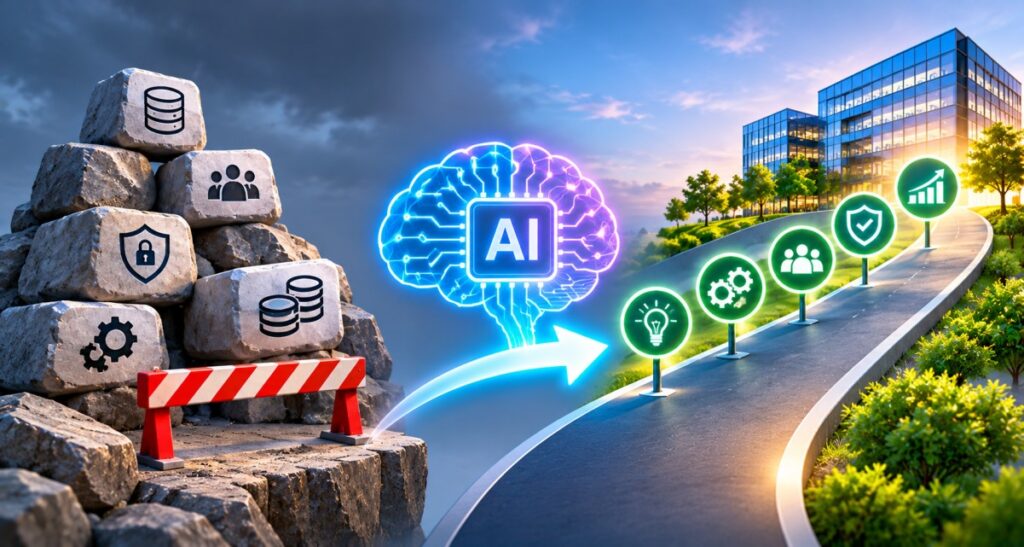
Common Challenges in Enterprise AI Adoption and How to Address Them
Even promising AI initiatives can struggle when organizations underestimate the work required to deploy them responsibly.
Data Quality and Information Silos
AI systems are only as useful as the information and context available to them. Outdated documents, inconsistent records, duplicated information, and fragmented data sources can produce unreliable results.
Recommended approach: Audit relevant data sources, assign data owners, improve documentation, and establish processes for maintaining accurate information. Apply access controls before connecting enterprise repositories to AI applications.
Security, Privacy, and Compliance Risks
Employees may unintentionally expose confidential business information by entering it into unapproved tools. AI applications may also create new pathways for unauthorized access or disclosure.
Recommended approach: Establish approved-tool policies, assess provider data-handling practices, use appropriate enterprise security controls, and conduct privacy and security reviews before deployment.
Unreliable Outputs and Hallucinations
Generative AI can produce plausible-sounding statements that are inaccurate or unsupported. This is particularly concerning when applications provide technical guidance, customer information, or business recommendations.
Recommended approach: Ground responses in reliable sources where possible, test the system against representative questions, provide citations or source links where appropriate, and introduce human review for consequential outputs.
Unclear Return on Investment
Some organizations adopt AI because it is popular without establishing whether it addresses a meaningful business problem. This can lead to rising subscription, infrastructure, integration, and oversight costs without corresponding value.
Recommended approach: Define success metrics before implementation. Measure total costs alongside productivity, quality, turnaround time, and user satisfaction. Expand only when results justify the investment.
Resistance to Organizational Change
Employees may be uncertain about new workflows, concerned about the reliability of AI, or unclear about their responsibilities.
Recommended approach: Involve employees early, communicate the purpose of implementation, provide practical training, and create channels for feedback. Treat adoption as a business change initiative rather than a software installation project.
The Future of Enterprise AI Adoption
Generative AI adoption is likely to become increasingly integrated with enterprise applications, internal knowledge systems, software development environments, and business process automation.
Organizations are also exploring AI agents that can perform multiple steps toward a defined objective by interacting with approved tools and data sources. Such systems may support tasks such as preparing reports, coordinating workflows, or retrieving information across business applications.
However, greater autonomy also introduces greater operational risk. Organizations must define which actions AI systems may perform, which require human approval, and how activities are monitored or reversed.
The long-term advantage will not necessarily belong to organizations using the largest number of AI tools. It will belong to organizations that combine suitable technology with high-quality data, capable employees, secure architecture, and disciplined execution.
Businesses that build these foundations can move beyond isolated experiments and establish AI capabilities that support continuous improvement and long-term competitiveness.
Generative AI offers businesses a significant opportunity to improve productivity, strengthen customer experiences, streamline operations, and accelerate innovation. However, achieving these outcomes requires more than experimenting with new tools. It requires a structured strategy that connects business objectives with the right technology, reliable data, secure implementation, employee readiness, and measurable performance.
The journey from experimentation to enterprise adoption begins with identifying the right use cases and validating their value. It continues through scalable architecture, responsible governance, effective integration, and continuous improvement. Organizations that approach this journey strategically can build AI capabilities that support sustainable growth rather than isolated technological achievements.
Ready to explore the potential of generative AI for your business?
Partner with Paraminfo to explore technology-driven business transformation, identify suitable AI opportunities, and develop an implementation approach aligned with your organizational goals.
Frequently Asked Questions
1. What is generative AI in business?
Generative AI in business refers to the use of AI systems that generate or transform content, summarize information, assist with coding, and support selected business workflows. Organizations use it to improve productivity, customer service, knowledge access, and innovation while maintaining appropriate oversight.
2. What is enterprise AI adoption?
Enterprise AI adoption is the process of integrating AI capabilities into organizational workflows, systems, and operations at a sustainable scale. It involves selecting suitable use cases, preparing data, establishing security and governance, training employees, and measuring business results.
3. How can businesses move from AI experimentation to enterprise adoption?
Businesses should identify a specific problem, prioritize use cases, run a controlled proof of concept, evaluate results, address security and governance requirements, integrate successful solutions, and expand them through a structured implementation roadmap.
4. What are the biggest challenges in generative AI implementation?
Common challenges include poor data quality, inaccurate outputs, information security risks, privacy concerns, integration complexity, unclear ROI, and employee resistance. A combination of technical safeguards, clear governance, employee training, and measurable objectives can help address these challenges.
5. Which industries can benefit from generative AI?
Industries such as IT, banking, retail, healthcare, manufacturing, education, real estate, professional services, and telecommunications can explore generative AI for suitable tasks. The most appropriate applications depend on the organization’s data, business needs, risk profile, and regulatory environment.
