

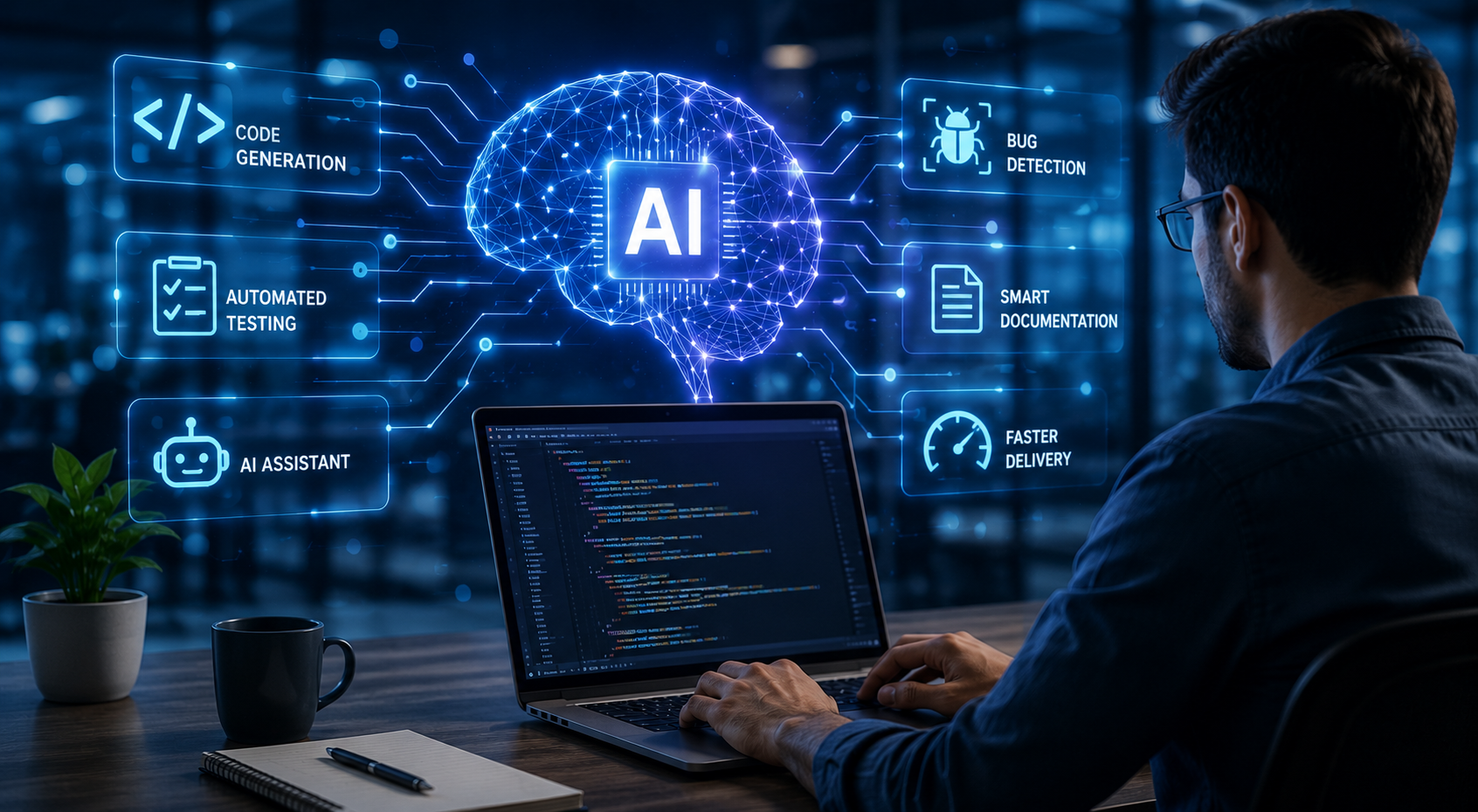
Generative AI is no longer an experimental technology – it has become a practical business tool that helps organizations build software faster, improve developer productivity, and streamline digital transformation initiatives. From startups to global enterprises, companies are integrating AI into their software development lifecycle to automate repetitive tasks, enhance collaboration, and accelerate product delivery.
Modern AI-powered development tools enable engineering teams to generate code, create technical documentation, identify bugs, and automate testing. Instead of replacing software developers, these tools act as intelligent assistants that help teams focus on solving complex business problems while reducing time spent on routine coding activities.
Businesses investing in Generative AI in Software Development are often combining it with cloud technologies, enterprise platforms, and digital transformation strategies to create scalable, future-ready applications. Organizations looking to modernize legacy systems can also benefit from broader Digital Enterprise Transformation initiatives that integrate AI across business processes.
Key Applications of Generative AI Across the Software Development Lifecycle
Generative AI supports developers throughout the entire software development lifecycle, improving efficiency from planning to deployment.
1. Requirement Analysis and Project Planning
Before development begins, AI can help transform business requirements into technical documentation. Development teams can generate user stories, acceptance criteria, workflow diagrams, and API specifications, reducing manual effort during the planning phase.
This allows project managers, business analysts, and developers to collaborate more effectively while maintaining consistency across project documentation.
2. Intelligent Code Generation
One of the most significant advantages of AI-powered software development is intelligent code generation. Developers can describe the required functionality in natural language, and AI tools generate code snippets in multiple programming languages.
Examples include:
- REST API development
- Database queries
- Authentication modules
- Front-end components
- Backend services
- Automation scripts
While AI-generated code accelerates development, experienced developers should always review and optimize the output to align with organizational coding standards.
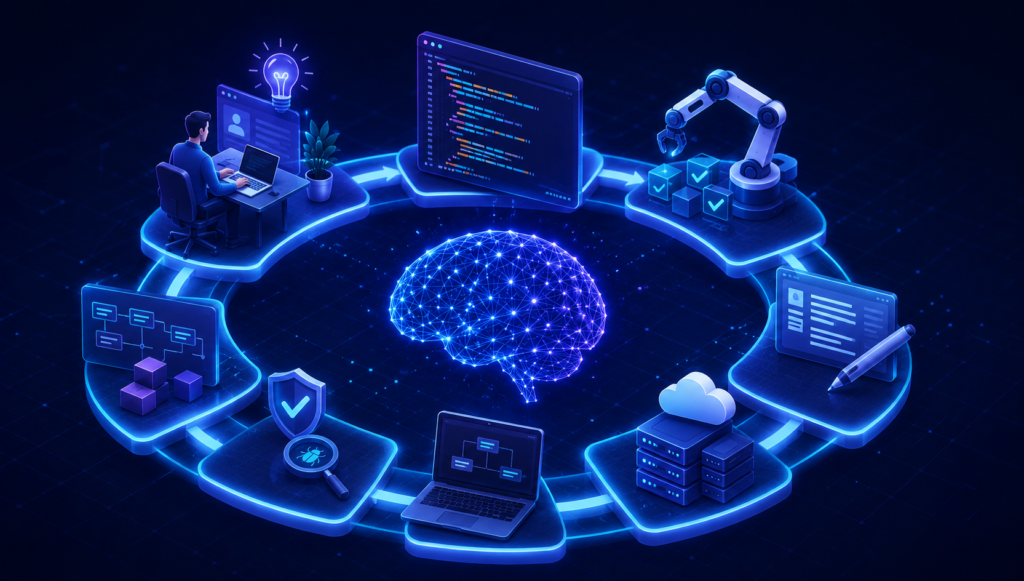
Organizations delivering enterprise-grade applications often combine AI-assisted development with structured Product Development methodologies to ensure scalability, maintainability, and long-term business value.
3. AI-Assisted Code Reviews
Manual code reviews remain an essential quality assurance practice, but AI significantly reduces review time by identifying:
- Code duplication
- Syntax issues
- Performance bottlenecks
- Missing documentation
- Potential security vulnerabilities
- Naming inconsistencies
AI-powered reviews allow senior developers to focus on architectural decisions and business logic instead of routine code inspections.
4. Faster Software Testing
Testing is often one of the most time-consuming stages of software development. Generative AI can automatically generate:
- Unit tests
- API test cases
- Regression test scenarios
- Mock datasets
- Edge-case validations
This improves test coverage while reducing manual effort. AI can also recommend additional test cases based on changes in application logic, helping teams maintain software quality throughout continuous integration and deployment (CI/CD) pipelines.
5. Intelligent Documentation
Keeping documentation updated is a common challenge for development teams. AI simplifies this process by automatically generating:
- API documentation
- README files
- Technical specifications
- Deployment guides
- Release notes
- Code comments
Accurate documentation improves collaboration across distributed teams and reduces onboarding time for new developers.
Benefits of Generative AI in Software Development
Organizations adopting AI-powered software development are experiencing measurable improvements across engineering, operations, and business functions.
Increased Developer Productivity
Developers spend less time writing repetitive code and more time designing scalable architectures, solving technical challenges, and building innovative features.
Faster Time-to-Market
By accelerating coding, testing, debugging, and documentation, AI enables organizations to deliver applications faster without compromising quality.
Improved Software Quality
AI-powered code reviews and automated testing help identify issues earlier in the development lifecycle, reducing defects before production deployment.
Enhanced Collaboration
Generative AI helps developers understand unfamiliar codebases, explain complex logic, and generate clear documentation, improving collaboration across cross-functional teams.
Better Resource Utilization
Organizations can allocate engineering resources more effectively by automating repetitive development tasks and allowing skilled professionals to focus on strategic initiatives.
Businesses scaling engineering teams often combine AI-driven development with IT Staff Outsourcing or Dedicated Development Teams to access specialized expertise while maintaining project agility.
Challenges of AI-Powered Software Development
Despite its advantages, Generative AI should be implemented responsibly.
| Challenge | Recommended Approach |
| AI-generated code may contain errors | Always conduct manual code reviews |
| Security vulnerabilities | Follow secure coding practices and security testing |
| Compliance requirements | Implement governance policies for AI usage |
| Privacy concerns | Use enterprise-grade AI platforms with appropriate safeguards |
| Skill dependency | Train developers in prompt engineering and AI best practices |
AI should be viewed as a collaborative tool rather than a replacement for experienced software engineers.

Best Practices for Successfully Adopting Generative AI
Organizations planning to integrate AI into software development should consider the following best practices:
- Define clear AI governance policies.
- Use AI to enhance not replace developer expertise.
- Validate AI-generated code through testing and peer reviews.
- Protect proprietary source code by using approved AI platforms.
- Train engineering teams on effective prompt engineering techniques.
- Continuously monitor AI outputs for accuracy, security, and compliance.
Combining AI with cloud platforms, managed services, and enterprise applications can further improve operational efficiency and support long-term digital transformation goals.
The Future of Software Development with Generative AI
The future of software development will increasingly combine human creativity with AI-driven automation. Emerging trends include:

- AI-native integrated development environments (IDEs)
- Autonomous software testing
- Intelligent code optimization
- AI-assisted software architecture design
- Predictive DevOps and infrastructure management
- Enterprise AI governance frameworks
- Low-code and no-code application acceleration
As these technologies mature, organizations that adopt AI strategically will be better positioned to deliver innovative digital products while maintaining security, quality, and scalability.
Ready to integrate Generative AI into your software development strategy?
At ParamInfo, we help organizations accelerate innovation through Artificial Intelligence, Product Development, Digital Enterprise Transformation, Managed Services, Cloud Solutions, and IT Staff Augmentation. Whether you’re modernizing legacy applications or building AI-powered solutions, our experts can help you deliver secure, scalable, and future-ready software. Learn more about ParamInfo Artificial Intelligence services or explore Digital Enterprise Transformation to start your AI journey today.
Frequently Asked Questions (FAQs)
1. What is Generative AI in software development?
Generative AI in software development refers to the use of artificial intelligence models to assist developers with tasks such as code generation, debugging, automated testing, documentation, and code optimization. It helps accelerate the software development lifecycle while improving productivity and efficiency.
2. How is Generative AI changing software development?
Generative AI is transforming software development by automating repetitive coding tasks, generating test cases, assisting with code reviews, creating technical documentation, and helping developers solve complex programming challenges faster. This enables organizations to reduce development time and improve software quality.
3. Can Generative AI replace software developers?
No. Generative AI is designed to assist developers, not replace them. While it can automate routine tasks and generate code, experienced software engineers are still essential for designing system architecture, validating AI-generated outputs, ensuring security, and solving complex business problems.
4. What are the benefits of using Generative AI in software development?
Key benefits include faster application development, improved developer productivity, automated testing, better code quality, enhanced collaboration, quicker documentation, reduced time-to-market, and more efficient use of engineering resources.
5. How does Generative AI improve software testing?
Generative AI can automatically generate unit tests, integration tests, API test cases, regression tests, mock data, and edge-case scenarios. This improves test coverage, reduces manual testing effort, and helps identify defects earlier in the development lifecycle.
6. Is AI-generated code secure?
AI-generated code can improve development speed, but it should always be reviewed by developers. Organizations should follow secure coding practices, perform security testing, conduct code reviews, and use enterprise-approved AI tools to minimize potential security risks.
7. Which stages of the software development lifecycle can benefit from Generative AI?
Generative AI can support multiple stages of the software development lifecycle, including requirement analysis, project planning, code generation, code reviews, software testing, technical documentation, debugging, deployment, and ongoing application maintenance.
8. What industries can benefit from Generative AI-powered software development?
Industries such as healthcare, banking and financial services, retail, manufacturing, telecommunications, education, logistics, government, and technology can all benefit from faster software delivery, improved automation, and increased development efficiency using Generative AI.
9. What are the challenges of adopting Generative AI in software development?
Some common challenges include code accuracy, security vulnerabilities, compliance requirements, data privacy concerns, intellectual property protection, and the need for developer training. These challenges can be addressed through proper governance, human oversight, and secure AI adoption practices.
10. How can businesses successfully implement Generative AI in software development?
Businesses should establish AI governance policies, choose secure enterprise AI platforms, train development teams on AI best practices, validate AI-generated code through testing and peer reviews, and integrate AI into existing DevOps and software development workflows.
11. How does Generative AI help reduce software development costs?
By automating repetitive tasks such as coding, testing, debugging, and documentation, Generative AI reduces manual effort, shortens development cycles, minimizes errors, and improves developer productivity. This can lead to lower operational costs and a faster return on investment.
12. Why should businesses partner with ParamInfo for AI-powered software development?
ParamInfo combines expertise in Artificial Intelligence, Product Development, Digital Enterprise Transformation, Cloud Solutions, Managed Services, and IT Staff Augmentation to help organizations build secure, scalable, and future-ready applications. Our experts help businesses integrate Generative AI responsibly while ensuring quality, compliance, and long-term business value.
