

Artificial intelligence is transforming how businesses operate, manage information, communicate with customers, and make decisions. From automating repetitive activities to improving employee productivity, AI-powered technologies are becoming an important part of modern business operations.
As organizations continue exploring digital transformation opportunities, understanding AI Copilots vs AI Agents has become increasingly important for businesses looking to improve efficiency and streamline workflows.
Although these terms are sometimes used interchangeably, they serve different purposes within a business environment. AI copilots primarily assist employees by providing information, generating content, analyzing data, and supporting everyday tasks. AI agents go a step further by understanding objectives, planning actions, interacting with connected applications, and executing multi-step workflows within predefined permissions.
For example, an AI copilot can help a marketing professional draft an email campaign, analyze customer feedback, or summarize a business report. An AI agent, on the other hand, can potentially coordinate a larger workflow by analyzing campaign requirements, organizing approved customer segments, preparing campaign materials, and scheduling authorized activities.
When comparing AI Copilots vs AI Agents, both technologies offer valuable opportunities, but selecting the right solution depends on business requirements, operational complexity, security considerations, and the level of autonomy an organization needs.
For enterprises, the important question is not simply which technology is more advanced. It is understanding how AI copilots and AI agents can complement employees, improve productivity, and support measurable business outcomes.
Tags: AI Copilots vs AI Agents, Artificial Intelligence, AI Automation, Enterprise AI, Business Productivity
Understanding AI Copilots
AI copilots are artificial intelligence-powered assistants designed to support people while performing their everyday tasks.
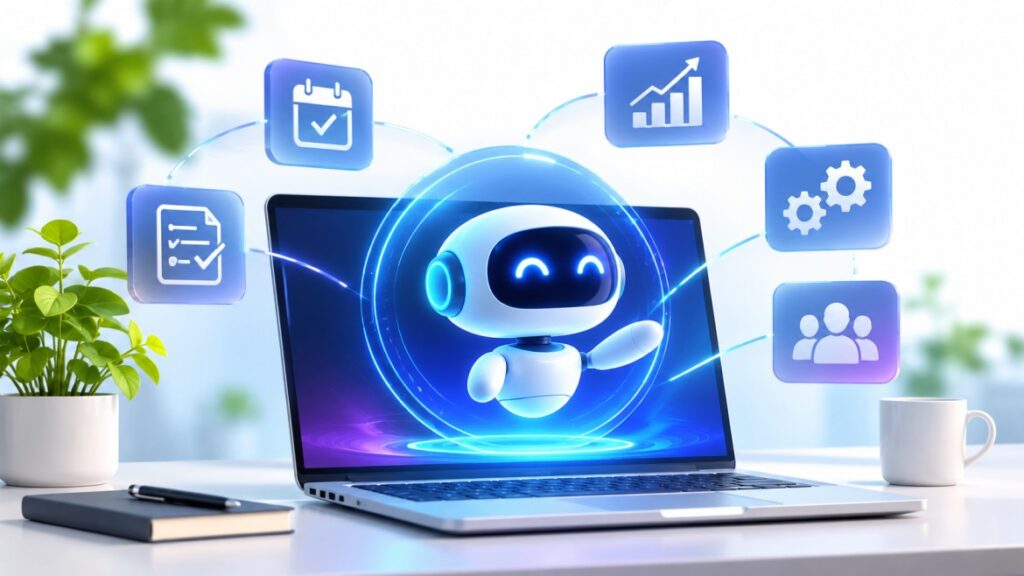
They work alongside employees by understanding natural-language instructions, generating suggestions, retrieving information, summarizing documents, and helping complete specific activities.
Unlike traditional software tools that depend entirely on manual instructions, AI copilots can interpret user requests and provide contextual assistance.
How AI Copilots Work
AI copilots typically use a combination of technologies to provide intelligent assistance.
- Large Language Models (LLMs): Help understand natural-language instructions and generate relevant responses.
- Natural Language Processing (NLP): Helps interpret user questions and understand their intent.
- Enterprise Data Integration: Connects AI copilots with approved business information and applications.
- Contextual Understanding: Uses relevant information from the current task to generate more useful responses.
- User Interaction: Allows employees to request assistance, review suggestions, and refine outputs.
For example, consider an employee preparing a business presentation.
Instead of manually reviewing multiple documents, the employee can ask an AI copilot to summarize key information, identify important insights, organize the findings, and prepare presentation content.
The employee remains responsible for reviewing the information and approving the final presentation.
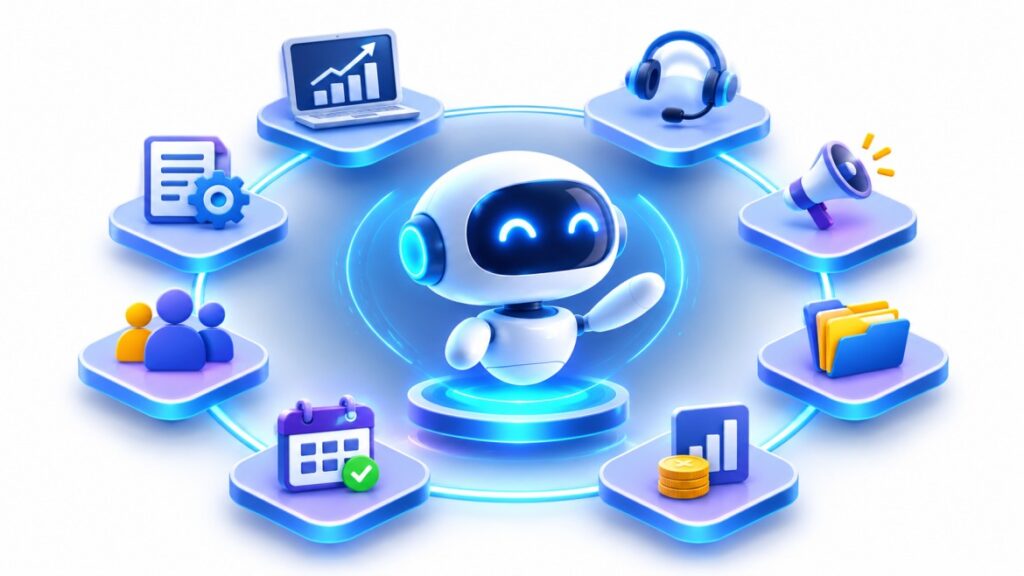
Common Business Applications of AI Copilots
1. Content Creation and Communication
AI copilots can help employees draft professional emails, prepare business proposals, create marketing content, and summarize conversations.
2. Data Analysis and Reporting
They can assist with analyzing spreadsheets, identifying patterns, generating summaries, and presenting business insights.
3. Customer Support Assistance
AI copilots can help customer service representatives retrieve relevant information, summarize customer interactions, and draft appropriate responses.
4. Software Development
Developers can use AI copilots to generate code suggestions, explain programming concepts, identify potential errors, and support documentation.
5. Employee Productivity
AI copilots can assist with meeting summaries, task organization, document preparation, and information retrieval.
These applications help employees complete tasks more efficiently while retaining control over important decisions.
Understanding AI Agents
AI agents are intelligent software systems designed to perform tasks, make decisions, and achieve specific objectives with varying levels of autonomy.
Unlike AI copilots, which primarily assist users when requested, AI agents can independently manage defined workflows, interact with connected applications, and determine appropriate next steps based on available information.
They can break complex objectives into smaller tasks, retrieve relevant information, use approved tools, and evaluate the results of their actions.
How AI Agents Work
AI agents typically combine multiple technologies to perform business activities.
- Artificial Intelligence: Helps analyze information and identify patterns.
- Large Language Models: Enable natural-language understanding, reasoning, and task planning.
- Memory and Context: Help maintain relevant information throughout a workflow.
- Tool Integration: Allows agents to interact with databases, APIs, CRM platforms, and enterprise applications.
- Workflow Execution: Enables agents to perform authorized tasks across connected systems.
- Human Oversight: Provides approval and supervision for sensitive or high-impact activities
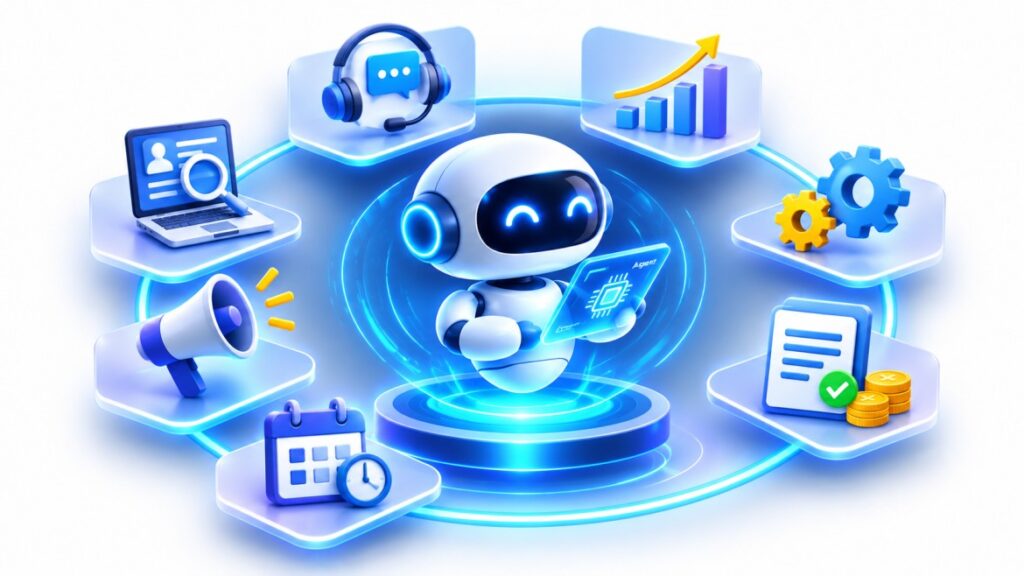
Common Business Applications of AI Agents
1. Intelligent Customer Support
AI agents can understand customer inquiries, retrieve relevant information, identify suitable responses, and manage routine requests within defined permissions.
2. Sales and Lead Management
AI agents can collect inquiry details, organize customer information, identify potential follow-up requirements, and update CRM records through approved integrations.
3. Business Process Automation
Organizations can use AI agents to coordinate multi-step workflows involving document retrieval, information validation, notifications, and application updates.
4. IT Operations Management
AI agents can help investigate system alerts, analyze operational information, summarize incidents, and recommend approved troubleshooting actions.
5. Human Resource Management
AI agents can assist employees with policy-related questions, onboarding coordination, document retrieval, and routine HR service requests.
6. Financial Operations
AI agents can help extract invoice information, identify discrepancies, organize financial records, and prepare transaction summaries for human review.
The important consideration is that AI agents should operate within clearly defined permissions. Their ability to perform actions does not mean they should have unrestricted access to business systems.
AI Copilots vs. AI Agents: Key Differences
Both technologies use artificial intelligence to improve business operations, but they differ in their working approaches, responsibilities, and levels of autonomy.
| Comparison factor | AI Copilots | AI Agents |
| Primary purpose | Assist employees | Execute defined objectives |
| Working approach | User-guided assistance | Goal-oriented execution |
| Interaction | Responds to user requests | Can initiate workflow steps |
| Decision-making | Suggests and supports decisions | Selects actions within defined boundaries |
| Task execution | Helps complete individual tasks | Coordinates multi-step tasks |
| Autonomy | Generally lower | Generally higher |
| Human involvement | User directs and reviews work | Supervision and approval depend on risk |
| System integration | Accesses relevant tools and data | Can interact with multiple connected systems |
| Best suited for | Individual productivity | Workflow and process execution |
| Example | Drafting a business proposal | Coordinating an approved proposal workflow |
Real-World Business Applications of AI Copilots and AI Agents
The applications of these technologies extend across multiple industries and business functions.
- Marketing and Sales
AI copilots:
- Generate marketing content and campaign ideas.
- Draft sales emails and proposals.
- Summarize customer feedback.
- Analyze marketing reports.
AI agents:
- Organize incoming sales inquiries.
- Coordinate approved customer follow-ups.
- Update CRM information.
- Prepare campaign performance summaries.
Business example: A marketing employee uses an AI copilot to develop a campaign strategy. An AI agent then helps organize approved campaign activities, retrieve performance information, and prepare reporting updates.
2. Customer Service
AI copilots:
- Suggest customer responses.
- Summarize previous conversations.
- Retrieve product information.
- Help representatives resolve customer questions.
AI agents:
- Handle routine customer inquiries.
- Retrieve order or service information.
- Update support tickets.
- Escalate complex requests.
Business example: A customer contacts a company regarding an order delay. An AI agent retrieves the relevant order information, checks approved delivery updates, prepares a response, and escalates the issue when necessary.
3. Finance and Accounting
AI copilots:
- Summarize financial reports.
- Explain spreadsheet data.
- Prepare financial summaries.
- Assist with budget analysis.
AI agents:
- Extract invoice information.
- Identify discrepancies.
- Organize payment-related records.
- Coordinate approval workflows.
Business example: A finance employee uses an AI copilot to understand monthly expense trends, while an AI agent helps organize invoice records and flag transactions requiring additional review.
4. Human Resources
AI copilots:
- Draft job descriptions.
- Prepare employee communications.
- Summarize HR policies.
- Assist with training materials.
AI agents:
- Coordinate onboarding activities.
- Retrieve approved employee information.
- Track pending documentation.
- Respond to routine HR service requests.
Business example: An HR professional uses a copilot to prepare onboarding materials, while an AI agent coordinates document reminders and updates authorized onboarding workflow records.
5. IT and Software Development
AI copilots:
- Suggest code.
- Explain technical documentation.
- Assist with debugging.
- Generate test cases.
AI agents:
- Coordinate software testing workflows.
- Investigate system alerts.
- Create incident summaries.
- Assist with approved deployment processes.
Business example: A developer uses an AI copilot to understand an error in an application. An authorized AI agent can subsequently collect relevant logs, run approved diagnostic checks, and prepare an incident report.
These applications demonstrate how copilots and agents can support employees while helping businesses improve coordination across departments
Benefits of AI Copilots and AI Agents for Businesses
Adopting these technologies can help organizations improve productivity, customer engagement, and operational performance.
- Improved Employee Productivity
AI copilots help employees complete routine knowledge-based activities faster.
They can assist with document preparation, information retrieval, communication, and data analysis, allowing employees to focus on higher-value responsibilities.
- Greater Workflow Efficiency
AI agents can coordinate multiple activities across connected applications.
This reduces the need for employees to manually transfer information between systems or repeatedly perform administrative tasks.
- Better Customer Experience
AI-powered solutions can support faster responses, more personalized interactions, and consistent information retrieval.
Businesses can use copilots to assist customer service representatives and agents to manage suitable routine customer requests.
- Improved Decision Support
AI copilots can help employees understand complex information, while AI agents can gather relevant data and prepare recommendations.
These capabilities support informed decision-making, although important business decisions should remain subject to appropriate human validation.
- Scalability and Operational Flexibility
As business requirements grow, organizations can introduce additional copilots and specialized agents for different departments.
This creates opportunities to expand AI adoption without redesigning every business process from the beginning.
Challenges of Implementing AI Copilots and AI Agents
Although AI-powered technologies offer several advantages, businesses should understand the challenges associated with implementation before integrating them into their operations.
1. Data Privacy and Security
AI copilots and agents may access confidential business information, customer records, employee data, and internal documents.
Organizations should establish appropriate access permissions, authentication mechanisms, data protection practices, and monitoring policies.
2. Integration with Existing Business Applications
Many organizations already use CRM platforms, ERP systems, databases, accounting software, and communication applications.
Integrating AI solutions with these systems requires proper technical planning. Poor integration can result in inconsistent information, duplicate records, and disconnected workflows.
3. Accuracy and Reliability
AI systems can sometimes generate incorrect information, misunderstand instructions, or produce unreliable recommendations.
Businesses should connect AI solutions to trusted information sources and implement validation mechanisms, particularly for financial, legal, and operational activities.
4. Implementation Costs
AI adoption involves expenses related to software development, licensing, infrastructure, integration, testing, maintenance, and employee training.
Organizations should evaluate the expected business value before investing in large-scale implementations.
5. Human Oversight and Accountability
AI copilots and agents should operate within clearly defined responsibilities.
Human approval is particularly important for financial transactions, contractual commitments, sensitive customer decisions, and other high-impact activities.
6. Employee Training and Adoption
Employees need to understand how to interact with AI copilots, review AI-generated information, and supervise agent-driven workflows.
AI copilots and AI agents are changing how organizations approach productivity, automation, and business operations. While AI copilots help employees complete tasks through intelligent assistance, AI agents take automation further by coordinating workflows, interacting with connected applications, and executing defined objectives.
Both technologies offer valuable opportunities for businesses looking to improve operational efficiency, enhance customer experiences, and simplify complex processes.
However, successful AI adoption requires more than implementing new tools. Organizations must understand their business requirements, evaluate existing infrastructure, prioritize data security, and establish appropriate human oversight.
The right combination of AI copilots, AI agents, and enterprise technology can help businesses create a more productive, connected, and future-ready working environment.
At Paraminfo, we believe technology should empower businesses to achieve more. From AI-powered applications and enterprise integration to custom software development and business process automation, Paraminfo helps organizations explore innovative technology solutions aligned with their business objectives.
Frequently Asked Questions
1. What is the difference between AI copilots and AI agents?
AI copilots assist users with tasks such as content creation, data analysis, and information retrieval. AI agents can independently coordinate and execute multiple tasks to achieve defined objectives within authorized boundaries.
2. How do AI copilots help businesses?
AI copilots help businesses improve employee productivity by assisting with email drafting, document preparation, data analysis, report generation, and customer communication.
3. What are the major applications of AI agents?
AI agents are commonly used for customer support, sales coordination, workflow automation, financial operations, IT management, and employee assistance.
4. Can AI copilots and AI agents work together?
Yes. AI copilots can provide an interface for employees to interact with AI capabilities, while specialized agents perform tasks and manage workflows through connected applications.
5. Are AI agents more advanced than AI copilots?
They serve different purposes rather than following a simple ranking. AI agents generally provide greater workflow autonomy, while AI copilots focus on assisting users with individual tasks and decisions.
6. Which industries can benefit from AI copilots and AI agents?
Industries such as healthcare, banking, finance, manufacturing, retail, education, IT, and professional services can use these technologies to improve productivity and streamline operations.
7. What are the challenges of implementing AI copilots and AI agents?
Common challenges include data privacy, cybersecurity, integration complexity, implementation costs, output accuracy, employee training, and governance.
8. Are AI copilots and AI agents secure for enterprise use?
They can be deployed responsibly with appropriate access controls, authentication, data protection, monitoring, audit trails, and human oversight. Security depends on the solution’s design and implementation.
9. Will AI copilots and AI agents replace employees?
These technologies are primarily designed to support employees and automate selected activities. Human judgment, creativity, accountability, relationship management, and strategic decision-making remain important.
