

Most enterprises have a knowledge problem that nobody talks about openly. Policies, SOPs, project documentation, compliance guidelines, product manuals, and HR handbooks exist somewhere across SharePoint folders, email threads, PDF libraries, and legacy intranets. When an employee needs a specific answer, they either spend 20 minutes searching for the right document, ask a colleague who may or may not know, or worse, act on outdated information they found first.
Retrieval-Augmented Generation, commonly called RAG, is the AI architecture that solves this problem. For UAE and Gulf enterprises investing in AI-powered knowledge management, RAG represents the most practical and production-ready approach available today. This two-part blog covers what RAG is and how it works (Part 1), then moves into how to build and deploy it for your organisation (Part 2).
What Is Retrieval-Augmented Generation?
RAG is an AI architecture that combines two capabilities: the ability to search and retrieve relevant information from a specific knowledge base, and the ability to generate clear, contextual answers based on what it retrieves.
A standard large language model (LLM) generates responses based on what it learned during training. It has a knowledge cutoff and no access to your organisation’s internal documents. Ask it about your company’s leave policy, your procurement approval thresholds, or a specific client contract clause, and it will either guess or tell you it does not know.
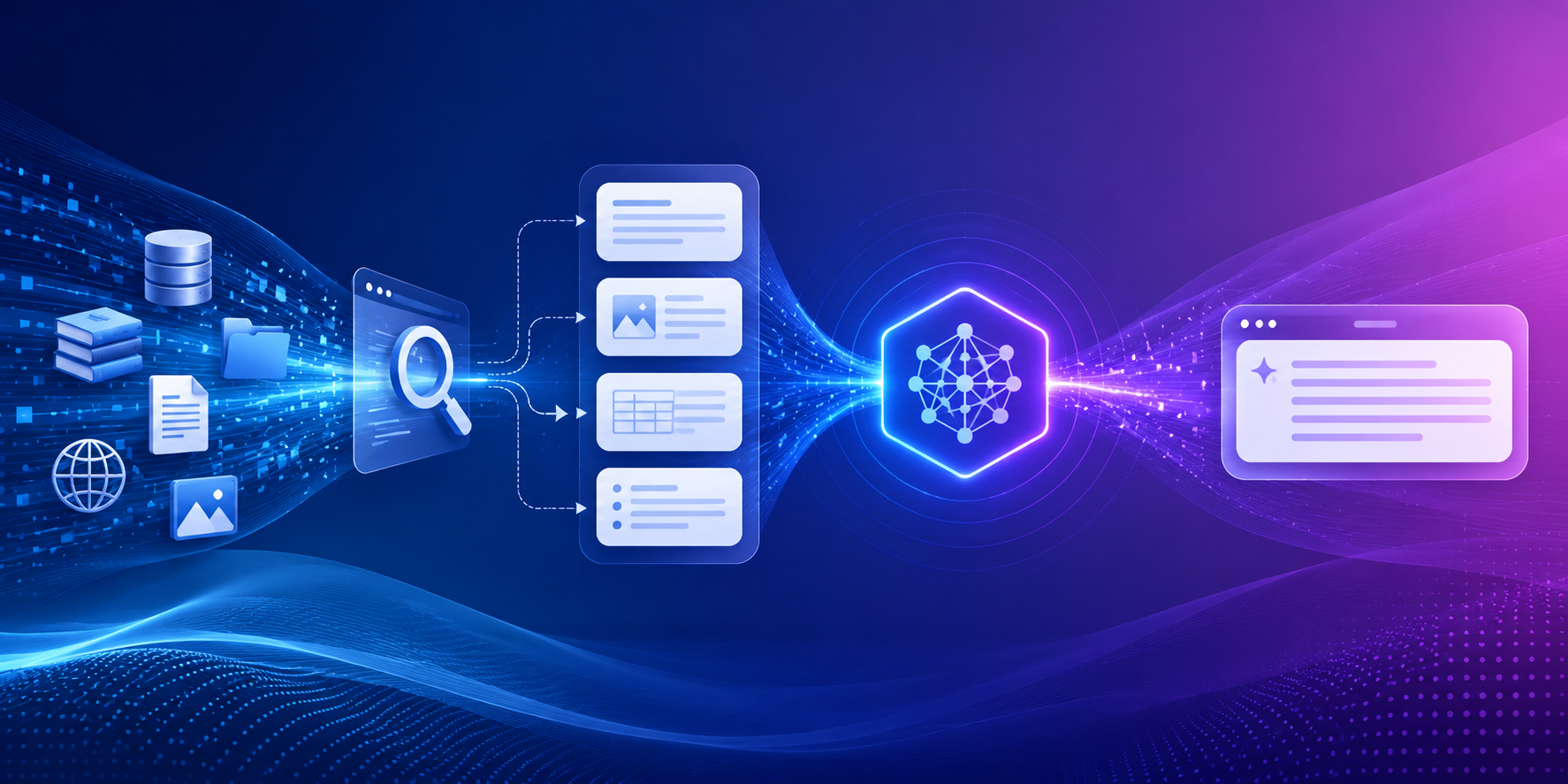
RAG changes this by giving the AI a retrieval layer. When a user asks a question, the system first searches your organisation’s knowledge base for the most relevant documents or passages, then passes those retrieved chunks to the LLM as context. The model generates its answer based on your actual content, not its training data. The result is accurate, sourced responses that reflect your organisation’s specific knowledge rather than generic information.
This is why RAG has become the dominant architecture for enterprise AI knowledge tools in 2025 and 2026. It is grounded, auditable, and significantly more reliable than asking a general-purpose AI model to answer organisation-specific questions.
Why Internal Knowledge Bases Are the Right Starting Point for Enterprise AI
Enterprises across the UAE and Gulf are exploring where AI delivers the most immediate business value. Internal knowledge management is consistently one of the strongest early use cases, and for straightforward reasons.
The volume of unstructured internal content is enormous. A mid-sized Dubai enterprise with 300 employees will typically have tens of thousands of documents spread across multiple systems. Most of that content is underutilised because it is too difficult to find quickly.
The cost of knowledge friction is real but often invisible. Every time an employee spends 15 minutes hunting for a policy document, asks a colleague to re-explain a process, or submits a ticket to the IT helpdesk for information that already exists in a document somewhere, that is a measurable productivity loss. Across a team of 300, these costs add up to significant working hours every month.
Compliance and audit requirements make accurate knowledge retrieval critical. In regulated industries such as banking, insurance, healthcare, and government, employees acting on outdated or misremembered policy information creates compliance risk. A RAG-powered knowledge system that always serves the current, approved version of a document removes a meaningful category of human error.
The UAE National AI Strategy 2031 is accelerating enterprise AI adoption across both public and private sectors. Organisations that build internal AI capability now, starting with contained, high-value use cases like internal knowledge management, are positioned ahead of competitors who are still evaluating where to begin. ParamInfo’s digital transformation advisory works with UAE enterprises to identify exactly these kinds of high-impact AI starting points and move them from concept to production.
How RAG Works: The Architecture Explained Simply
Understanding the mechanics of RAG at a conceptual level helps IT leaders ask the right questions when evaluating vendors or implementation partners. The architecture has four core components.
The knowledge base (your documents) RAG starts with your content: PDFs, Word documents, SharePoint pages, wiki articles, email attachments, database records, or any other source of structured or unstructured information. The quality and organisation of this content directly affects the quality of RAG outputs.
The ingestion and chunking pipeline Documents are processed, cleaned, and split into chunks, typically paragraphs or sections. Each chunk is converted into a vector embedding: a numerical representation of the meaning of that text. These embeddings are stored in a vector database. This process happens once during setup and is repeated incrementally as new documents are added.
The retrieval layer When a user submits a query, the system converts the query into a vector embedding and searches the vector database for the chunks most semantically similar to the question. The top-ranked chunks are retrieved and passed to the language model as context.
The generation layer The language model receives both the user’s question and the retrieved document chunks. It generates a response based on that specific context. Critically, a well-designed RAG system also returns citations or source references alongside the answer, so users can verify the information against the original document.
This architecture is what makes RAG fundamentally different from a standard chatbot or search function. It is not guessing or summarising from training data. It is retrieving and synthesising from your actual content.
What Types of Internal Knowledge Work Best for RAG
Not all enterprise content is equally suitable for a RAG system, at least not initially. Some knowledge types deliver faster and more reliable results.
High-value RAG use cases for UAE enterprises:
- HR and People Operations: leave policies, benefits documentation, onboarding guides, code of conduct, disciplinary procedures. These are high-frequency query areas where employees routinely need quick, accurate answers.
- IT and Helpdesk Knowledge: troubleshooting guides, system access procedures, software usage documentation. A RAG system here can deflect a significant proportion of tier-1 helpdesk tickets. This aligns naturally with ParamInfo’s IT helpdesk services, where AI-assisted knowledge retrieval can reduce resolution times and ticket volumes.
- Compliance and Regulatory Documentation: UAE Data Protection Law requirements, VAT compliance guides, industry-specific regulatory frameworks. For regulated industries, having employees able to query compliance documentation in plain language reduces the risk of policy misapplication.
- Finance and Procurement Policies: approval thresholds, vendor management procedures, expense policy, budgeting guidelines.
- Product and Technical Documentation: for businesses with complex product lines or technical service offerings, enabling sales and service teams to query technical documentation accurately reduces errors and speeds up client-facing responses.
- Project and Delivery Methodology: standard project frameworks, templates, lessons learned repositories, and past proposal libraries.
Content that needs preparation before RAG can work well:
Scanned documents without OCR, highly inconsistent formatting, content in mixed languages without clear language tagging, and documents containing conflicting or outdated versions of the same policy all create noise in a RAG system. A content audit and basic cleanup before ingestion pays significant dividends in output quality.
The Business Case for RAG in UAE Enterprises
IT directors and business leaders evaluating RAG for internal knowledge bases will need to build a business case. The value drivers are consistent across organisations of different sizes and industries.
Productivity recovery. If a 300-person organisation averages 20 minutes per day per person searching for information, and a RAG system reduces that by even 50%, the recovered productivity over a year is substantial. In knowledge-intensive industries such as consulting, legal, and financial services, the figure is higher.
Reduced helpdesk and support volume. A significant proportion of internal IT and HR helpdesk queries are questions about documented policies and procedures. A RAG-powered knowledge assistant can handle these without human intervention, reducing ticket volume and freeing helpdesk staff for more complex issues.
Compliance risk reduction. In regulated industries, a single compliance failure based on misremembered or misapplied policy can result in costs that dwarf the investment in a RAG system. Serving employees the current, approved version of every compliance document on demand is a meaningful risk management tool.
Faster onboarding. New hires spend weeks building the institutional knowledge that experienced employees carry in their heads. A RAG system gives new team members a way to query company knowledge independently, reducing the time burden on managers and accelerating the productivity ramp.
Knowledge retention. When experienced employees leave, their knowledge leaves with them unless it has been documented. A RAG system makes existing documentation more accessible and useful, creating an incentive to document knowledge rather than keep it tacit.
What Part 2 Covers
Part 1 has covered what RAG is, how it works, and why internal knowledge bases are the right starting point for UAE enterprises building AI capability. Part 2 moves into the practical implementation questions: how to choose the right RAG architecture for your environment, how to prepare your knowledge base for ingestion, the key decisions around vector databases and embedding models, how to handle Arabic-language content in Gulf deployments, and how to measure whether your RAG system is actually working.
For organisations ready to move ahead now, ParamInfo’s data analytics and software development teams have delivered AI-powered knowledge management solutions for UAE enterprises across banking, real estate, and professional services. Contact us at info@paraminfo.com to discuss your specific requirements.
Frequently Asked Questions (FAQ)
What is Retrieval-Augmented Generation (RAG) in simple terms?
RAG is an AI approach that gives a language model access to a specific set of documents before it generates an answer. Instead of relying on general training data, the model retrieves the most relevant passages from your knowledge base and bases its response on that content. The result is accurate, sourced answers that reflect your organisation’s actual documentation rather than generic information.
Why is RAG better than a standard enterprise search tool?
Traditional search returns a list of documents that might contain your answer. RAG returns the answer itself, synthesised from the most relevant content, with references back to the source documents. Users get a direct response in plain language rather than a list of links to navigate manually. For complex queries that span multiple documents, RAG is significantly more useful than keyword search.
Is RAG suitable for Arabic-language content in UAE enterprises?
Yes, though it requires careful selection of embedding models and language models that handle Arabic well, including Gulf Arabic dialects. Not all RAG implementations are equal in Arabic-language capability. This is one of the key technical decisions covered in Part 2 of this series.
What types of documents can a RAG system process?
RAG systems can process PDFs, Word documents, PowerPoint presentations, Excel files, SharePoint pages, web pages, plain text files, and database records, among others. Scanned documents require OCR processing before they can be ingested. The broader and better-organised your document library, the more useful the RAG system becomes.
How secure is a RAG system for sensitive internal documents?
Security in a RAG system depends entirely on how it is designed and deployed. A well-architected enterprise RAG system applies the same access controls as your existing document management system: users only retrieve content they are authorised to access. Data residency, encryption, and audit logging are design requirements, not optional features, particularly for organisations subject to the UAE Data Protection Law.
