

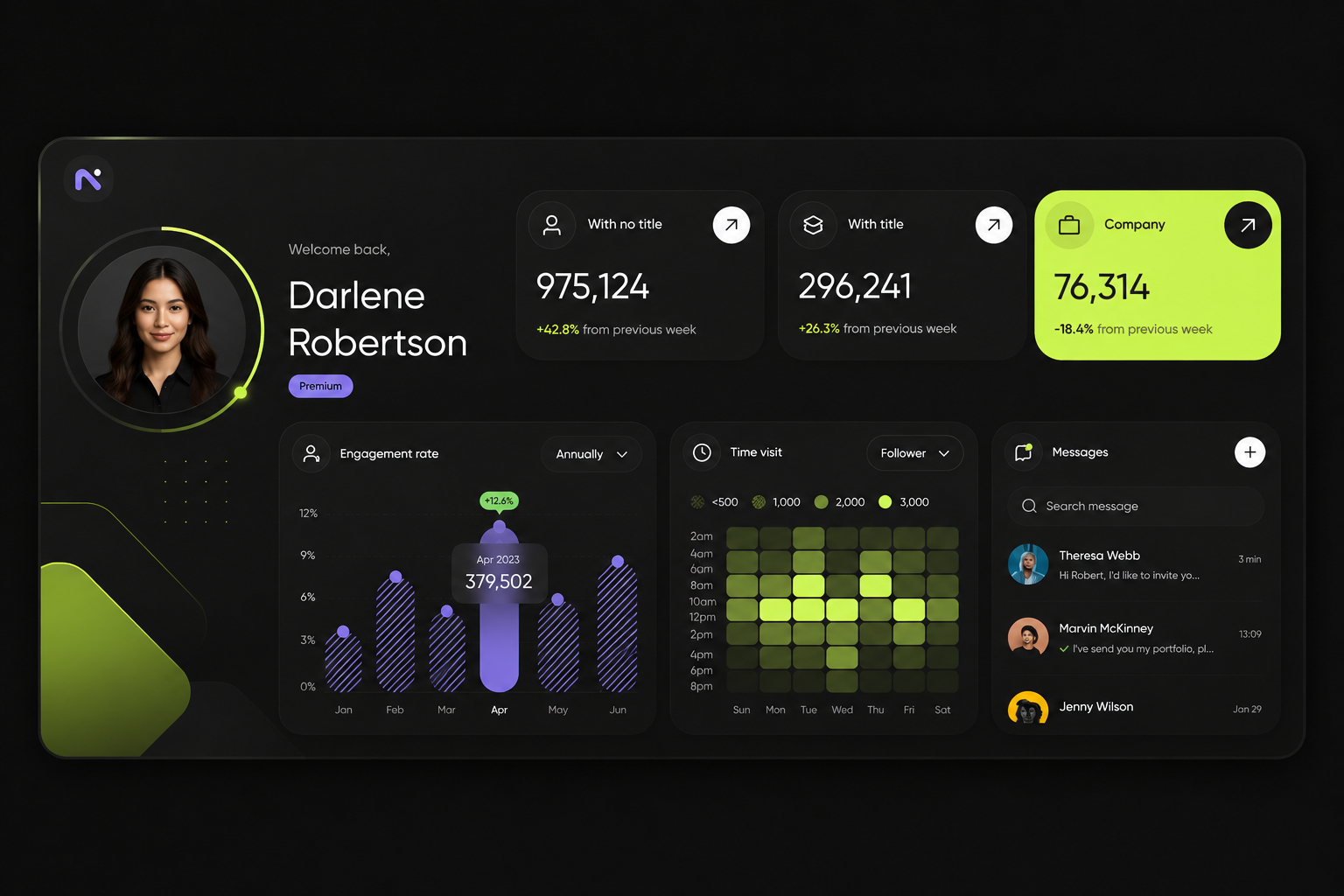
Executive Transformation Offices carry a difficult mandate: drive organisation-wide change while proving, in measurable terms, that the change is working. Employee performance tracking sits at the heart of that mandate. But most transformation offices either rely on dashboards that were built for operational teams rather than strategic oversight, or they track so many metrics that the signal is buried in noise.
A well-designed KPI dashboard for an Executive Transformation Office is not a reporting tool. It is a decision-making instrument. It tells leadership where momentum is building, where it is stalling, and what needs intervention before a quarterly review makes the problem visible too late. This two-part series covers the design principles and metric framework in Part 1, and the implementation, tooling, and integration decisions in Part 2.
Why Most Employee Performance Dashboards Fail at the Executive Level
The gap between what an operational performance dashboard shows and what an Executive Transformation Office actually needs is wider than most organisations realise.
Operational dashboards track activity: tasks completed, hours logged, tickets resolved, calls handled. These are useful for team leaders managing day-to-day output. They are not useful for a transformation office trying to understand whether the organisation is developing the capabilities and behaviours that a multi-year change programme requires.
The failure modes are consistent across UAE enterprises that ParamInfo works with across banking, government, real estate, and professional services.
Too many metrics with no hierarchy. A dashboard showing 40 KPIs gives leadership no starting point. Every metric looks equally important until something breaks, and by then the lagging indicators have already moved in the wrong direction.
Lagging indicators without leading ones. Revenue per employee, attrition rate, and training completion percentage are all lagging or coincident measures. By the time they shift, the underlying performance dynamic has been playing out for months. A transformation office needs leading indicators that predict future performance before it lands in the numbers.
No connection between individual performance and transformation objectives. An employee can score well on their standard performance review while actively resisting the behavioural changes the transformation requires. If the dashboard does not connect individual performance to transformation-specific milestones, it is measuring the wrong thing.
Static snapshots rather than trend lines. A single-period metric tells you where you are. A trend line tells you where you are going and how fast. Transformation offices need directional intelligence, not point-in-time readings.
Solving these problems requires starting with the strategic design of the dashboard before selecting any tooling or defining any metric.
The Design Principles That Separate Effective Transformation KPI Dashboards
Before a single metric is defined, the design framework needs to be established. These principles apply regardless of industry, organisation size, or which platform the dashboard eventually runs on.
Principle 1: Start With the Transformation Objectives, Not the Available Data
The most common dashboard design mistake is building around the data that already exists rather than the performance dimensions the transformation actually requires. If your transformation objective is to shift from a siloed, departmental operating model to a cross-functional, agile delivery model, then the performance metrics need to track cross-functional collaboration, decision velocity, and adaptive capacity. None of these appear in standard HR systems without intentional data design.
Define the three to five transformation objectives first. Then define what employee behaviour change each objective requires. Then define what measurable signals indicate that behaviour change is occurring. Only then should you ask what data exists or needs to be created.
Principle 2: Build a Three-Level Metric Hierarchy
Effective transformation KPI dashboards operate across three levels simultaneously.
Strategic level (executive view): Three to five headline indicators that reflect overall transformation progress. These are the metrics a board or CEO can absorb in 90 seconds and that tell them whether the transformation is on track, at risk, or in trouble.
Programme level (transformation office view): Ten to fifteen metrics that track performance across the major workstreams of the transformation. These are reviewed weekly or fortnightly by transformation leadership and used to identify where to focus attention and resources.
Operational level (team and individual view): The granular performance data that sits beneath the programme-level metrics and explains the movement at the levels above. Team leaders use these. The transformation office dips into them when a programme-level metric needs diagnosis.
This hierarchy means every metric has a clear owner, a clear purpose, and a clear connection to the strategic view above it.
Principle 3: Balance Leading and Lagging Indicators
A functional transformation KPI dashboard carries both types.
Lagging indicators confirm what has happened: revenue per employee, voluntary attrition rate, customer satisfaction scores, process cycle times. These are important for validation and accountability, but they tell you about the past.
Leading indicators predict what is about to happen: adoption rates for new tools and processes, engagement scores on transformation-specific change programmes, capability assessment results, cross-functional project participation rates, and manager quality scores from direct reports. These tell you where to intervene before the lagging indicators confirm a problem.
A healthy executive transformation dashboard typically runs a roughly 40:60 split, with 40% lagging indicators for accountability and 60% leading indicators for intervention.
Principle 4: Make Accountability Explicit in the Visualisation
Every KPI on the dashboard should have a named owner, a baseline, a target, a current value, and a directional trend. These five elements together create the conditions for accountability without turning the dashboard into a performance review tool.
The owner is the person responsible for moving the metric, not necessarily the person being measured. The baseline is where performance stood at the start of the transformation programme. The target is the agreed destination with a timeframe attached. The current value and the directional trend together tell you whether the target is reachable on the current trajectory.
Without all five elements, a metric on a transformation dashboard is decoration rather than a decision-making tool.
The Core KPI Framework for Employee Performance in Transformation Contexts
With the design principles in place, the metric framework can be constructed. The following categories cover the dimensions of employee performance that matter most in an Executive Transformation Office context.
Category 1: Capability Development Metrics
Transformation programmes succeed or fail based on whether the organisation is building the capabilities the new operating model requires. These metrics track that development.
- Capability gap closure rate: the percentage of identified skill gaps per role that have been addressed through training, hiring, or restructuring within the programme period.
- Certification and upskilling completion rate: not just training attendance, but demonstrated capability acquisition through assessment or certification.
- Internal mobility rate: the proportion of transformation-critical roles filled by internal candidates, indicating that capability development is translating into deployable talent.
- Learning velocity: the average time from capability gap identification to gap closure, tracked across departments and compared against programme benchmarks.
For UAE enterprises accelerating digital transformation under the UAE National AI Strategy 2031, capability development metrics are particularly critical. The gap between required digital skills and current workforce capability is one of the most commonly cited barriers to transformation progress across Gulf enterprises.
Category 2: Adoption and Engagement Metrics
New systems, processes, and ways of working only deliver value when they are actually adopted. Adoption metrics are among the strongest leading indicators available to a transformation office.
- Process adoption rate: the percentage of employees following new standard processes versus reverting to legacy approaches. This requires process instrumentation, not self-reporting.
- Digital tool activation and sustained usage: distinguishing between employees who have been onboarded to a new platform and those who are using it with sufficient frequency and depth to be genuinely productive on it.
- Change programme participation rate: attendance, completion, and active engagement rates for transformation-specific change management activities.
- Manager adoption index: whether line managers are modelling the new behaviours the transformation requires, since manager behaviour is the single most predictive factor in team-level adoption.
ParamInfo’s data analytics services support organisations in designing the data capture architecture needed to make adoption metrics reliable rather than anecdotal, particularly in environments where multiple systems need to be instrumented simultaneously.
Category 3: Collaboration and Agility Metrics
If the transformation is moving the organisation toward more cross-functional, agile ways of working, then the KPI framework must track those dimensions directly.
- Cross-functional project participation: the proportion of employees who have contributed to at least one cross-departmental initiative within the measurement period.
- Decision velocity: average time from decision trigger to decision made across defined decision categories. Organisations that are genuinely becoming more agile make decisions faster.
- Dependency reduction rate: the extent to which teams are becoming more self-sufficient versus escalating decisions upward or waiting on other teams to proceed.
- Retrospective action closure rate: for organisations adopting agile delivery practices, the percentage of actions identified in retrospectives that are completed before the next retrospective cycle.
Category 4: Performance Outcome Metrics
These are the results-layer metrics that connect employee performance to business outcomes the transformation was designed to deliver.
- Productivity per employee: output per head, defined in terms relevant to the function, adjusted for complexity and measured against pre-transformation baseline.
- Quality rates: error rates, rework rates, customer complaint rates, and first-time-right rates across key processes, compared to pre-transformation performance.
- Employee performance distribution: tracking whether performance is improving across the distribution, not just at the top. Transformations that only improve the performance of already-high performers are not delivering systemic change.
- Time-to-full-productivity for new hires: how quickly new employees reach target performance levels, which reflects the quality of the onboarding and capability transfer mechanisms the transformation is building.
Category 5: Wellbeing and Retention Risk Metrics
Transformation programmes that push hard on capability, adoption, and performance without monitoring employee wellbeing tend to produce attrition spikes at the worst possible moment, typically 12 to 18 months in when the programme is in its most demanding phase.
- Engagement score trend: not point-in-time engagement scores but the directional trend, measured at least quarterly during the transformation period.
- Voluntary attrition rate by critical role category: overall attrition is a lagging measure, but attrition in specific roles that are critical to the transformation is an early warning signal.
- Manager effectiveness scores: direct report ratings of manager quality, aggregated at department level. Managers who are struggling are a significant attrition risk factor.
- Workload distribution index: whether transformation-related work is being concentrated on a small group of high performers or distributed appropriately across the team.
Building the Dashboard Structure: What the Executive View Should Actually Look Like
The executive-level transformation dashboard should be a single screen, or a single page if it is a static report, that answers five questions without requiring any drilling down.
Is the transformation on track overall? A single composite indicator, built from weighted component metrics, that gives leadership a directional read within three seconds.
Which workstreams are performing above expectations, on track, or at risk? A simple red-amber-green view across the major programme workstreams, with the current trend direction alongside the status indicator.
What are the top three areas requiring executive attention? An automatically surfaced summary of the metrics that have moved most significantly in the wrong direction since the last reporting period.
Where is momentum strongest? Highlighting positive outliers is as important as flagging problems. Transformation offices that only use dashboards to identify what is broken miss the opportunity to understand what is working and accelerate it.
What is the trajectory? A rolling 90-day trend line for the five or six most critical headline metrics, so leadership can see whether the programme is accelerating, sustaining, or decelerating.
ParamInfo’s digital transformation advisory team has worked with Executive Transformation Offices across the UAE and Gulf to design exactly this kind of layered KPI architecture, ensuring that the strategic view is genuinely useful at board level while the operational detail is available for the teams who need to act on it.
Frequently Asked Questions (FAQ)
What is a KPI dashboard for an Executive Transformation Office?
A KPI dashboard for an Executive Transformation Office is a structured performance tracking tool designed specifically to measure progress against transformation objectives, not just operational output. It tracks employee capability development, adoption of new ways of working, collaboration patterns, and business outcome metrics, all mapped to the specific change programme the organisation is running. Unlike standard HR performance dashboards, it is built to support strategic decision-making rather than individual appraisal.
How many KPIs should an executive transformation dashboard include?
At the executive level, three to five headline indicators are sufficient for a single-screen strategic view. Below that, a transformation office typically tracks ten to fifteen programme-level metrics across its major workstreams. The full operational metric set beneath that can be larger, but each metric at every level must have a clear owner, a baseline, and a defined target. Dashboards with more than five executive-level KPIs consistently lead to decision paralysis rather than faster decision-making.
What is the difference between leading and lagging KPIs in a transformation context?
Lagging KPIs confirm what has already happened, such as attrition rate, revenue per employee, and training completion. Leading KPIs predict what is about to happen, such as tool adoption rates, capability gap closure velocity, and manager effectiveness scores. A well-designed transformation dashboard carries both, with a stronger emphasis on leading indicators so the transformation office can intervene before problems appear in the headline numbers.
How do you measure employee performance during a digital transformation in the UAE?
Employee performance during a UAE digital transformation should be measured across four dimensions: capability development, adoption of new processes and tools, collaboration and agility, and business outcome metrics. UAE enterprises should also factor in the pace of digital skill requirements driven by the UAE National AI Strategy 2031 and ensure that capability metrics are mapped against the specific skills the organisation’s technology roadmap demands.
How often should executive transformation KPI dashboards be reviewed?
Executive-level metrics should be reviewed monthly, with a formal trend review at least quarterly. Programme-level metrics should be reviewed weekly or fortnightly by the transformation office leadership team. Operational metrics should be available in real time for team leaders but reviewed formally on a weekly cycle. The review rhythm is as important as the dashboard design. Metrics that are not reviewed and acted on consistently lose credibility with the teams whose performance they are tracking.
