


The real estate industry is experiencing a significant digital transformation. From property discovery and lead generation to customer relationship management and property management, AI in real estate is changing how property businesses operate and interact with customers.
Today’s property buyers expect more than attractive property listings. They want quick responses, accurate property information, personalized recommendations, transparent communication, and convenient digital experiences. At the same time, real estate developers, brokers, property consultants, and management companies must handle increasing customer inquiries, multiple property listings, documentation, appointments, and operational responsibilities.
Traditional automation has already helped real estate businesses simplify repetitive activities such as sending follow-up emails, scheduling property visits, updating customer records, and managing sales inquiries. However, as customer expectations and business operations become more complex, conventional rule-based systems may not always provide the flexibility required.
This is where AI in real estate is creating new opportunities. Artificial intelligence agents can understand customer requests, analyze property-related information, recommend suitable solutions, and coordinate activities across connected business applications.
Unlike traditional automation, which follows predefined instructions, AI agents can respond to different situations using contextual information and predefined business objectives. This makes AI in real estate particularly useful for businesses looking to deliver more personalized customer experiences and improve operational efficiency.
For example, a traditional system might automatically send a property brochure after receiving an inquiry. An AI-powered agent could understand the buyer’s preferred location, budget, property type, and requirements before presenting relevant property options and arranging a discussion with a sales representative.
For real estate businesses looking to improve operational efficiency and customer engagement, understanding the differences between these technologies is becoming increasingly important.
In this blog, we explore how AI agents and traditional automation work, their applications in real estate, their benefits and challenges, and how property businesses can adopt intelligent technology effectively.
Understanding Traditional Automation
Traditional automation refers to the use of predefined rules, software applications, and workflows to perform repetitive business activities without requiring continuous manual involvement.

Businesses across industries manage several interconnected processes, including customer inquiries, lead management, communication, sales coordination, documentation, payment reminders, and operational activities. Handling these tasks manually can consume considerable time and create inefficiencies.
Traditional automation helps simplify these activities by connecting software applications and establishing structured workflows.
How Traditional Automation Works
Traditional automation follows a predefined sequence of instructions. When a particular event or condition occurs, the system automatically performs an assigned task.
For example, when a potential customer submits an inquiry through a company website, the automated system can:
- Capture the customer’s contact information.
- Store the inquiry in a Customer Relationship Management (CRM) system.
- Send an automatic acknowledgment email.
- Assign the lead to an appropriate sales representative.
- Schedule a follow-up notification.
- Update the lead status based on predefined conditions.
This reduces repetitive administrative work and helps employees manage customer inquiries more systematically.
Common Applications of Traditional Automation

1. Automated Lead Management
Businesses receive inquiries through websites, advertisements, social media, and other digital channels. Automation systems can collect these inquiries and organize them in a centralized CRM platform.
2. Data Management
Businesses can automate data entry, information updates, and synchronization across connected applications, reducing repetitive manual work.
3. Appointment Scheduling
Automated scheduling tools allow customers and employees to select available time slots for meetings, consultations, and other appointments.
4. Customer Notifications
Email and SMS automation can send confirmations, payment reminders, appointment notifications, and other routine updates.
5. Documentation Management
Workflow automation can help organize document submissions, track approval stages, and notify employees when documentation requires attention.
Understanding AI Agents
AI agents are intelligent software systems designed to understand objectives, process information, use connected tools, and perform multiple tasks within predefined boundaries.
They can help businesses manage customer interactions, analyze information, support employees, and coordinate operational activities.
Unlike conventional automation, AI agents can interpret natural-language requests and use contextual information to determine appropriate next steps.
How AI Agents Work
AI agents typically combine several technologies:
- Artificial Intelligence: Helps interpret information and identify relevant patterns.
- Large Language Models (LLMs): Enable natural-language understanding and conversational interactions.
- Enterprise Integrations: Connect agents with CRM platforms, databases, websites, and business applications.
- Knowledge Retrieval: Helps retrieve relevant information from approved documents and internal databases.
- Workflow Execution: Enables agents to perform authorized actions through connected tools.
- Human Oversight: Ensures that sensitive decisions and important business activities receive appropriate review.
For example, imagine a potential customer visiting a company’s website.
Instead of simply receiving an automated acknowledgment, the customer can interact with an AI-powered virtual assistant.
The assistant can understand the customer’s requirements, retrieve relevant information from approved business databases, answer questions, and help schedule an appointment.
The sales team can also receive a structured summary of the conversation, making the follow-up process more efficient.
AI Agents vs. Traditional Automation: Key Differences
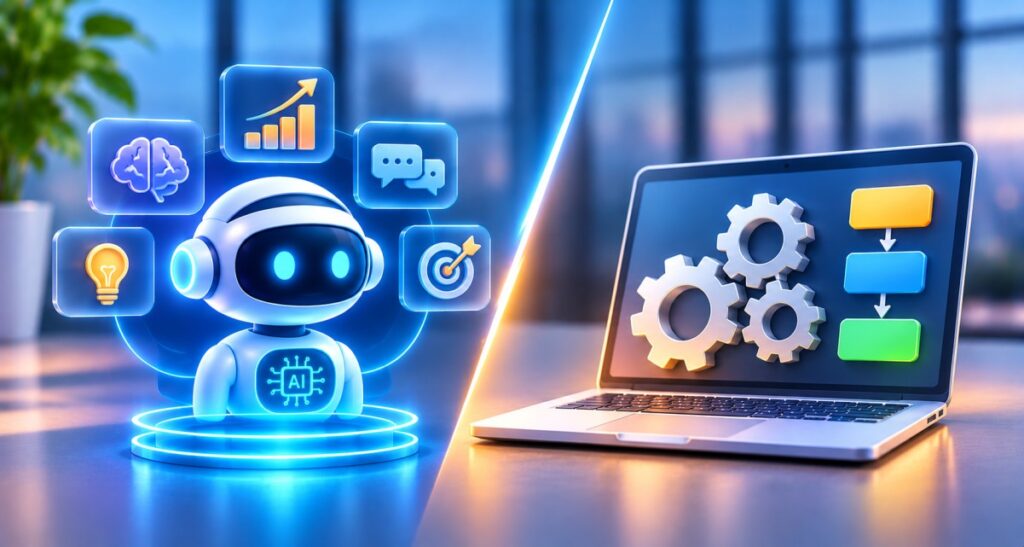
Both technologies help businesses improve operational efficiency, but their capabilities and implementation requirements differ.
| Comparison factor | Traditional automation | AI agents |
| Working approach | Predefined rules | Goal-oriented execution |
| Customer interaction | Fixed responses | Contextual conversations |
| Lead management | Automatic capture and assignment | Intelligent lead qualification |
| Information retrieval | Predefined searches | Contextual information retrieval |
| Decision-making | Rule-based | AI-assisted contextual reasoning |
| Document processing | Structured extraction | Contextual document understanding |
| Flexibility | Limited | Higher, within defined boundaries |
| Integration | Workflow-based | Tool-based and workflow-based |
| Human involvement | Exception handling | Supervision and approval |
| Best application | Repetitive business processes | Complex, information-intensive activities |
The key difference is not that AI agents can replace every existing automation system. Rather, they introduce intelligence into processes where traditional automation alone may not be sufficient.
For businesses across industries, combining both approaches can create a more balanced technology environment.
Benefits of AI Agents and Automation for Businesses
Adopting intelligent technologies can help organizations improve several aspects of their operations.
1. Improved Customer Engagement
Modern customers expect quick and relevant responses to their questions.
AI-powered assistants can provide round-the-clock initial assistance, retrieve relevant business information, and help customers move towards the next stage of their journey.
This can reduce communication delays and improve the overall digital customer experience.
2. Better Lead Management
Lead generation is an important part of business growth.
AI agents can help sales teams understand customer preferences, organize inquiry information, and identify potential follow-up priorities.
When integrated with CRM systems, these capabilities can create a more structured lead management process.
3. Increased Operational Efficiency
Employees frequently spend time on repetitive administrative activities.
Combining traditional automation with AI agents can reduce manual effort in inquiry handling, document processing, appointment coordination, and routine customer communication.
4. More Personalized Recommendations
AI-powered recommendation systems can use customer preferences and verified business information to present relevant options.
This can make the customer experience more convenient and reduce the time spent searching through unrelated information.
5. Improved Business Insights
AI systems can help analyze customer interactions, business performance, historical information, and operational data.
These insights can support decisions related to marketing campaigns, resource planning, customer engagement, and business operations.
However, AI-generated insights should be validated against reliable business data before being used for important decisions.
How Businesses Can Successfully Adopt AI Agents
Implementing AI technology requires more than selecting an AI platform. Businesses need a clear strategy that connects technology investments with operational objectives.
Here is a practical adoption approach.
Step 1: Identify Business Challenges
Start by understanding existing operational difficulties.
For example:
- Delayed customer responses.
- Poor lead follow-up.
- Time-consuming property searches.
- Repetitive document processing.
- Disconnected business applications.
Identifying these challenges helps businesses determine where AI agents can provide meaningful improvements.
Step 2: Evaluate Existing Technology Infrastructure
Review existing CRM systems, databases, websites, property portals, and communication platforms.
Determine whether these systems can support secure integrations with AI-powered applications.
Step 3: Select a Suitable Pilot Project
Rather than transforming every department simultaneously, start with a manageable project.
An AI-powered property inquiry assistant or automated lead qualification system can be a suitable starting point for some organizations.
Step 4: Establish Data Governance and Security
Define what information AI agents can access, what actions they can perform, and when human approval is necessary.
Ensure that customer information is processed according to applicable privacy requirements.
Step 5: Measure Business Performance
Evaluate implementation through measurable indicators such as:
- Average customer response time.
- Lead follow-up completion rate.
- Property inquiry conversion rate.
- Customer satisfaction.
- Document processing time.
- Cost per lead.
- Employee productivity.
Step 6: Improve and Expand
Review pilot performance, identify limitations, and improve the solution before expanding it to additional business operations.
This gradual approach helps organizations manage implementation risks while building confidence in intelligent automation.
Challenges of Implementing AI Agents in Businesses
Although AI agents offer several opportunities, organizations should evaluate potential challenges before implementing them. Understanding these challenges helps businesses adopt AI responsibly while maintaining operational efficiency, security, and reliability.
1. Data Privacy and Security
Businesses collect sensitive information, including customer names, contact details, financial records, employee information, and confidential business documents.
AI systems that access this information must be designed with appropriate security controls, access permissions, data protection practices, and transparency.
Organizations should establish clear policies regarding data access, storage, processing, and usage to minimize potential security risks.
2. Integration with Existing Business Systems
Many organizations already use CRM platforms, accounting software, ERP systems, databases, and customer communication tools.
Introducing AI agents requires appropriate integration with these applications.
Without proper integration, businesses may encounter inconsistent information, duplicate records, disconnected workflows, and difficulties in managing data across multiple platforms.
3. Accuracy and Reliability of Information
Incorrect or misleading information generated by AI systems can negatively affect customer trust and business decisions.
For example, an AI agent should not present unverified financial figures, contractual details, product specifications, or business information as confirmed facts.
Organizations should connect AI systems to reliable information sources and establish processes for regularly reviewing and updating business data.
4. Implementation Costs and Employee Training
AI adoption involves several investments, including software development, infrastructure, system integration, testing, monitoring, and employee training.
Businesses should begin by identifying specific operational challenges and evaluating the expected return on investment before expanding implementation.
Employees should also receive appropriate training to understand how to use AI tools effectively and identify situations that require human intervention.
5. Human Supervision and Accountability
AI agents can perform multiple tasks independently within predefined boundaries, but they should not have unrestricted authority over important business decisions.
Organizations should establish clear approval mechanisms, accountability policies, and monitoring processes.
Human review is particularly important when decisions involve legal, financial, contractual, security-related, or customer-sensitive consequences.
The business landscape is evolving towards a more connected, intelligent, and technology-driven environment. Traditional automation continues to play an important role in simplifying repetitive tasks and improving operational efficiency, while AI agents introduce new opportunities for intelligent decision-making, personalized customer engagement, workflow management, and business process optimization.
However, successful digital transformation is not simply about adopting the latest technologies. It involves understanding business requirements, identifying operational challenges, implementing the right solutions, and ensuring that technology delivers measurable value.
Organizations that strategically combine AI agents, traditional automation, and enterprise software can improve productivity, streamline business operations, enhance customer experiences, and build a stronger foundation for future growth.
At Paraminfo, we believe in empowering businesses through innovative and reliable technology solutions. From AI-powered applications and business process automation to custom software development and enterprise application integration, Paraminfo helps organizations explore technology opportunities that align with their business objectives.
Frequently Asked Questions
1. What is artificial intelligence (AI)?
Artificial intelligence (AI) refers to technologies that enable machines and software applications to perform tasks that typically require human intelligence, such as understanding language, analyzing information, recognizing patterns, and supporting decision-making.
2. What are AI agents?
AI agents are intelligent software systems that can understand instructions, analyze information, make decisions, and perform tasks using connected tools and applications to achieve specific objectives.
3. How are AI agents different from traditional automation?
Traditional automation follows predefined rules and workflows to complete repetitive tasks. AI agents can interpret contextual information, respond to changing situations, and perform multiple tasks based on defined goals and permissions.
4. What are the major benefits of AI agents for businesses?
AI agents can help businesses improve operational efficiency, automate complex workflows, enhance customer engagement, process information faster, support decision-making, and reduce repetitive manual activities.
5. Can AI agents improve customer experience?
Yes. AI agents can provide personalized responses, understand customer inquiries, retrieve relevant information, assist with routine requests, and offer support across multiple communication channels.
6. What are the common applications of traditional automation?
Traditional automation is commonly used for data entry, email notifications, invoice processing, appointment scheduling, report generation, workflow management, and other repetitive business processes.
7. Are AI agents suitable for every business?
Not necessarily. AI agents are most useful for processes involving contextual understanding, multiple information sources, and dynamic decision-making. Traditional automation may be more suitable for stable, repetitive, and rule-based tasks.
8. What challenges should businesses consider before implementing AI agents?
Businesses should consider data security, privacy, integration complexity, implementation costs, output accuracy, regulatory compliance, and human oversight before deploying AI agents.
9. Can AI agents and traditional automation work together?
Yes. Combining AI agents with traditional automation can help organizations build intelligent workflows. AI agents can interpret information and determine appropriate actions, while automation systems execute predefined processes consistently.
