

Technology is evolving faster than ever, reshaping how businesses operate, compete, and innovate. As organizations accelerate their digital transformation initiatives, emerging technologies are becoming the foundation of operational efficiency, customer experience, cybersecurity, and business growth. From intelligent AI agents and advanced cloud platforms to enterprise knowledge systems and modernized IT infrastructure, 2026 is set to redefine the future of enterprise technology.
Businesses are no longer investing in technology simply to stay current-they are adopting innovative solutions to automate complex processes, improve decision-making, strengthen security, and create scalable digital ecosystems. Organizations that embrace these trends early will gain a significant competitive advantage, while those relying on legacy systems may struggle to keep pace with changing market demands.
At ParamInfo, we help organizations embrace these technological advancements through Artificial Intelligence, Cloud Migration Services, Digital Enterprise Transformation, Managed IT Services, and Enterprise Technology Solutions. By aligning technology with business objectives, we enable enterprises to innovate faster while maintaining security and operational resilience.
In this article, we’ll explore the Top New Technology Trends in 2026 that are transforming industries and helping businesses prepare for the future.
Why Technology Trends Matter in 2026
Technology is no longer a support function-it is a strategic business driver. Modern enterprises depend on digital platforms to improve efficiency, deliver personalized customer experiences, optimize operations, and make data-driven decisions.
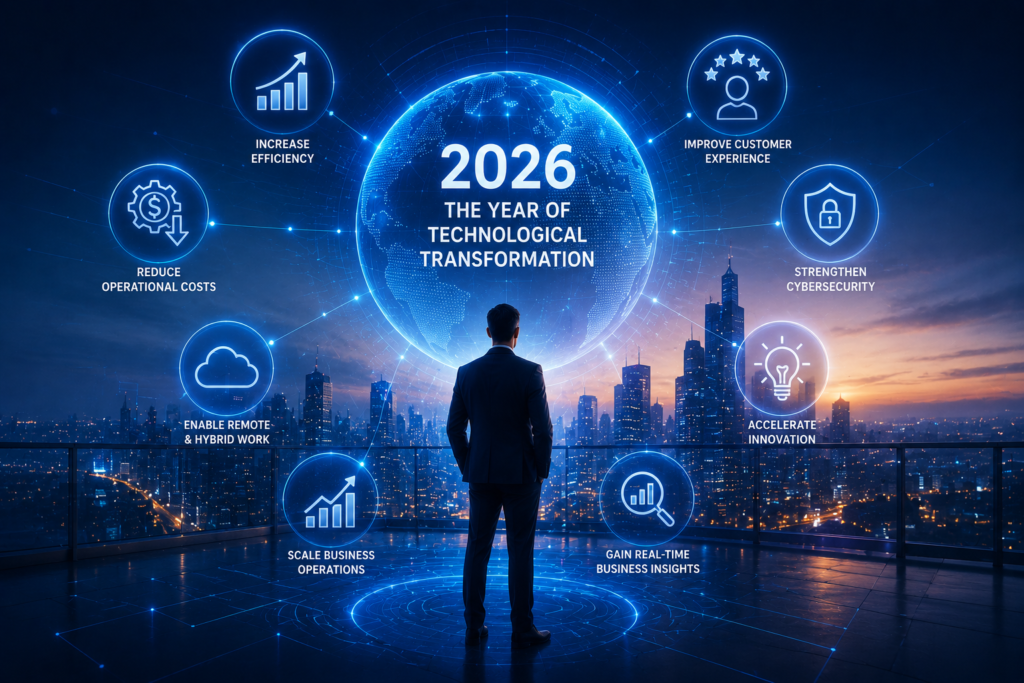
The rapid adoption of artificial intelligence, cloud computing, automation, and intelligent data platforms is creating new opportunities across industries. Organizations that invest in emerging technologies today will be better positioned to:
- Increase operational efficiency
- Improve customer satisfaction
- Strengthen cybersecurity
- Reduce operational costs
- Enable remote and hybrid work
- Accelerate innovation
- Scale business operations
- Gain real-time business insights
Technology leaders must continuously evaluate emerging trends to ensure their organizations remain competitive in an increasingly digital economy.
Businesses embarking on this journey often begin with a comprehensive Digital Enterprise Transformation strategy that modernizes systems, streamlines processes, and prepares organizations for future innovation.
1. Agentic AI and Workflow Automation
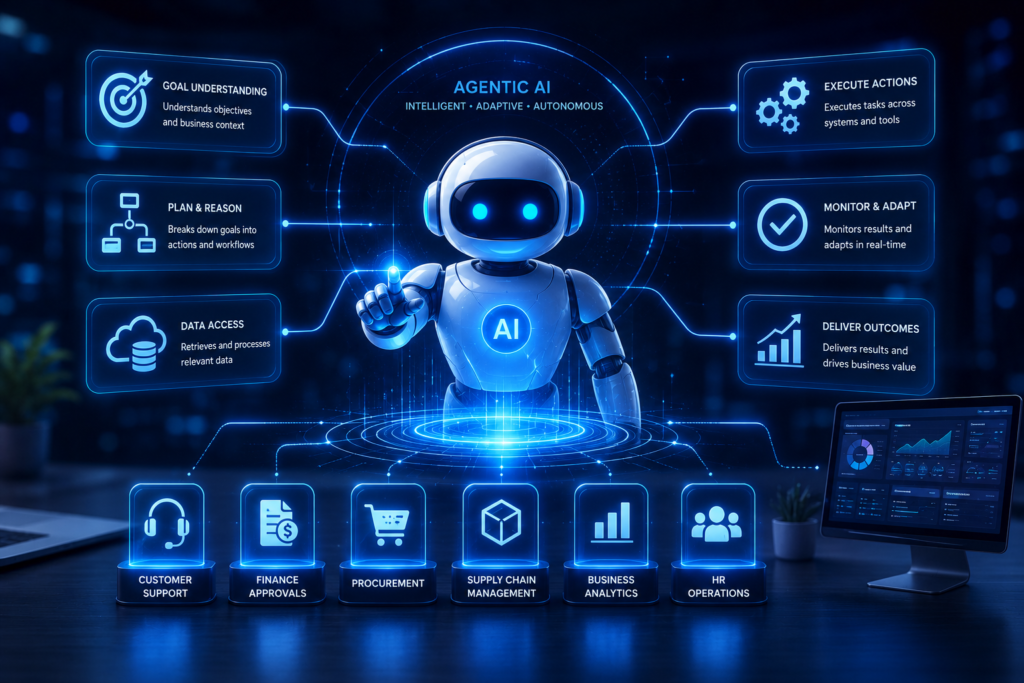
One of the most significant technology trends in 2026 is the rise of Agentic AI-intelligent AI systems capable of planning, reasoning, making decisions, and executing complex tasks with minimal human intervention.
Unlike traditional automation tools that perform predefined actions, Agentic AI continuously learns, adapts, and coordinates multiple workflows across business functions. These AI-powered agents can independently manage tasks such as customer support, IT operations, finance approvals, supply chain optimization, and business analytics.
Business Benefits
Organizations adopting Agentic AI can achieve:
- Faster decision-making
- Automated business workflows
- Improved operational efficiency
- Reduced manual effort
- Higher employee productivity
- Lower operational costs
For example, an AI agent can automatically analyze incoming customer requests, classify them, retrieve relevant information, generate responses, escalate complex cases, and update CRM systems-all without manual intervention.
As enterprises expand their AI initiatives, Agentic AI will become a key driver of intelligent business operations and digital transformation.
2. Multimodal AI
Artificial Intelligence is evolving beyond text-based interactions. In 2026, Multimodal AI is becoming increasingly important because it can understand and process multiple types of data simultaneously, including text, images, audio, video, and documents.
Instead of analyzing a single data source, multimodal AI combines information from different formats to generate more accurate insights and responses.
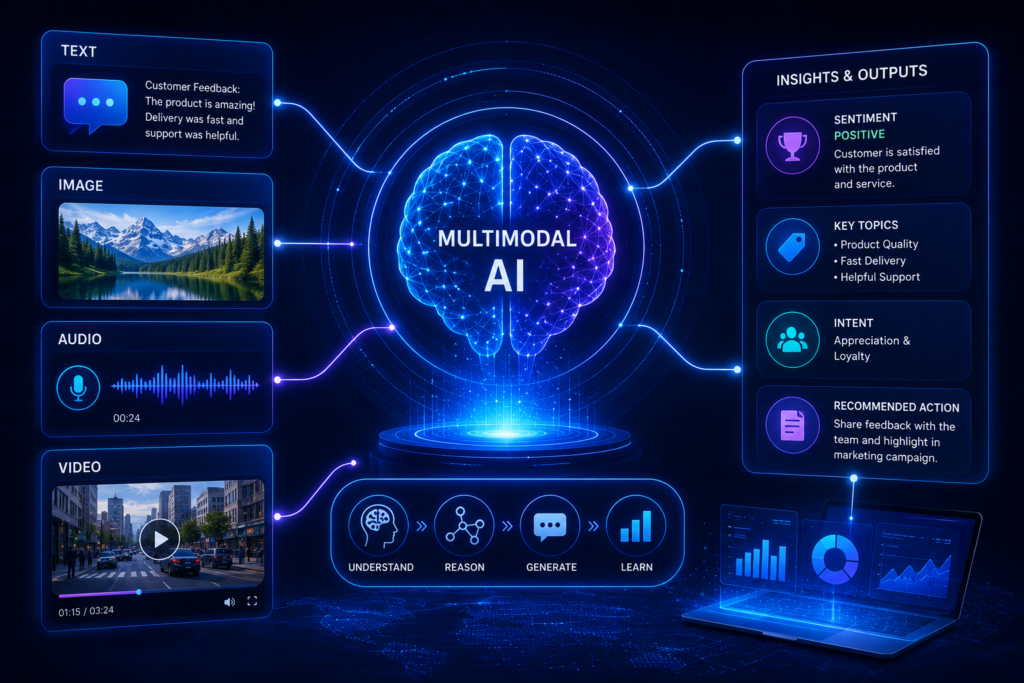
For example, a customer service solution powered by multimodal AI can:
- Analyze written customer queries
- Interpret uploaded images
- Process voice conversations
- Review supporting documents
- Generate contextual responses
This capability enables organizations to deliver more personalized and intelligent customer experiences.
Industry Applications
Multimodal AI is transforming industries such as:
- Healthcare
- Banking
- Retail
- Manufacturing
- Insurance
- Telecommunications
- Education
Businesses implementing multimodal AI gain a deeper understanding of customer interactions while improving operational efficiency and decision-making.
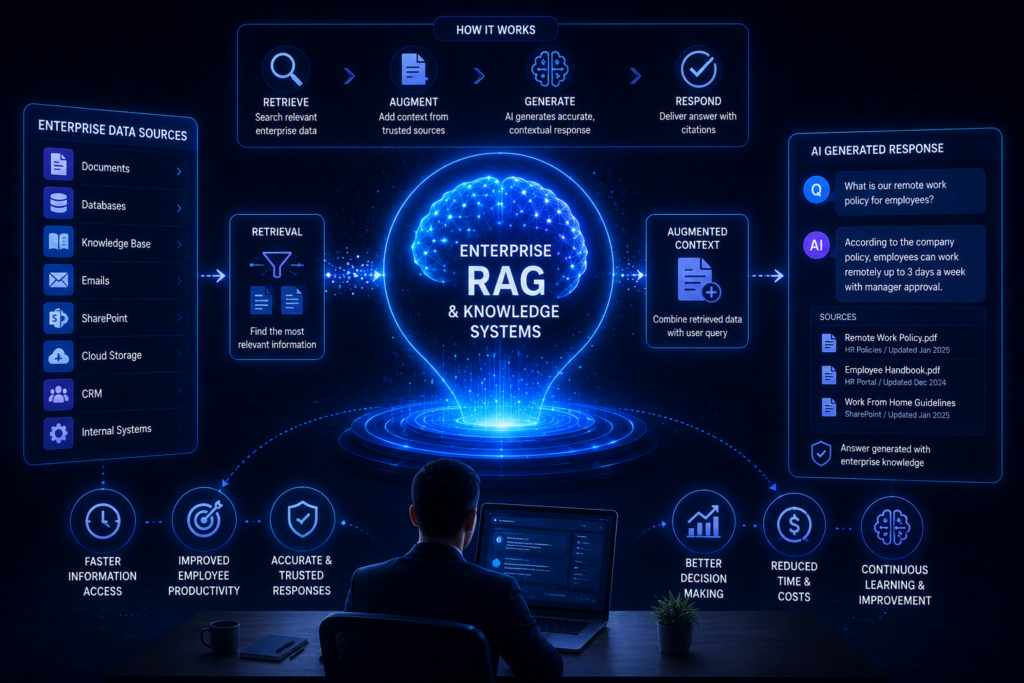
3. Enterprise RAG and Knowledge Systems
One of the biggest challenges organizations face is making vast amounts of enterprise knowledge easily accessible. Employees often spend valuable time searching through documents, emails, internal portals, and databases to find the information they need.
This is where Enterprise Retrieval-Augmented Generation (RAG) is making a significant impact.
RAG combines large language models with enterprise knowledge bases to provide accurate, context-aware responses using an organization’s own data. Instead of relying solely on publicly available information, RAG retrieves relevant internal content before generating answers.
Key Benefits
Enterprise RAG enables businesses to:
- Improve knowledge sharing
- Reduce information silos
- Enhance employee productivity
- Deliver more accurate AI responses
- Support intelligent search across enterprise systems
For example, employees can ask questions such as:
“What is our latest cybersecurity policy?”
The AI system retrieves the most recent internal document and generates an accurate response based on verified company information.
Organizations planning AI adoption should establish secure enterprise knowledge systems to maximize the value of their business data.
AI Governance, Security, and Compliance
As AI becomes integrated into business-critical operations, organizations must ensure that AI systems operate responsibly, securely, and in compliance with regulatory requirements.
AI Governance is rapidly becoming a board-level priority.
Key governance areas include:
- Ethical AI usage
- Data privacy
- Model transparency
- Bias detection
- Regulatory compliance
- Access controls
- Auditability
- Risk management
Businesses must establish governance frameworks that define how AI models are developed, deployed, monitored, and maintained throughout their lifecycle.
Why It Matters
Without proper governance, organizations may face:
- Regulatory penalties
- Data privacy violations
- Reputational damage
- Inaccurate AI outputs
- Security vulnerabilities
Responsible AI governance helps organizations build trust while ensuring AI technologies are used safely and effectively.
5. Cyber Resilience and Continuous Security Validation
Cybersecurity continues to evolve as cyber threats become more sophisticated. Traditional security approaches that focus solely on prevention are no longer sufficient.
In 2026, organizations are shifting toward Cyber Resilience, which focuses on preventing attacks while ensuring rapid recovery when incidents occur.
Cyber resilience combines:
- Continuous security monitoring
- Threat detection
- Vulnerability management
- Incident response
- Disaster recovery
- Business continuity planning
An important aspect of this approach is Continuous Security Validation, where organizations regularly test their security controls to identify weaknesses before attackers can exploit them.
Business Benefits
Organizations adopting cyber resilience strategies can:
- Minimize downtime
- Protect sensitive business data
- Reduce cyber risks
- Improve regulatory compliance
- Strengthen customer trust
- Enhance business continuity
As digital ecosystems become increasingly interconnected, cyber resilience will remain one of the most important technology investments for enterprises worldwide.
Businesses can further strengthen their technology landscape by adopting Managed IT Services, which provide proactive infrastructure monitoring, security management, and continuous system optimization.
6. Cloud 3.0: The Next Generation of Cloud Computing
Cloud computing has evolved significantly over the past decade. In 2026, organizations are moving beyond basic cloud adoption to embrace Cloud 3.0-an intelligent, AI-powered, secure, and sustainable cloud ecosystem.
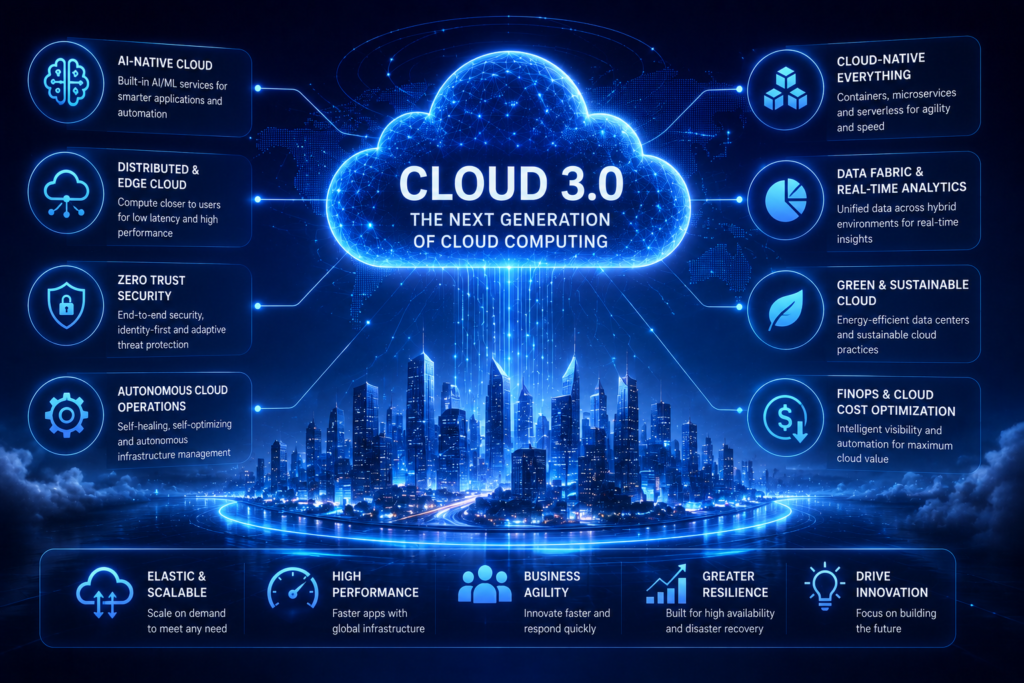
Cloud 3.0 is designed to provide businesses with greater flexibility, improved performance, enhanced security, and better cost optimization. Unlike traditional cloud environments, it integrates artificial intelligence, automation, edge computing, multi-cloud strategies, and intelligent workload management into a unified platform.
Key Features of Cloud 3.0
- AI-driven cloud management
- Multi-cloud and hybrid cloud environments
- Edge computing integration
- Intelligent workload optimization
- Enhanced cloud security
- Automated resource allocation
- Sustainable cloud infrastructure
Cloud 3.0 enables businesses to deploy applications faster, improve disaster recovery capabilities, and optimize infrastructure costs while maintaining high availability.
Organizations planning their cloud journey should adopt a structured migration strategy to maximize business value and minimize operational risks.
7. Data Modernization: Unlocking the Value of Enterprise Data
Data has become one of the most valuable assets for modern organizations. However, many businesses still rely on fragmented databases, outdated storage systems, and disconnected applications that limit their ability to make informed decisions.
Data Modernization focuses on transforming legacy data environments into scalable, cloud-ready, and AI-enabled platforms that support real-time analytics and business intelligence.
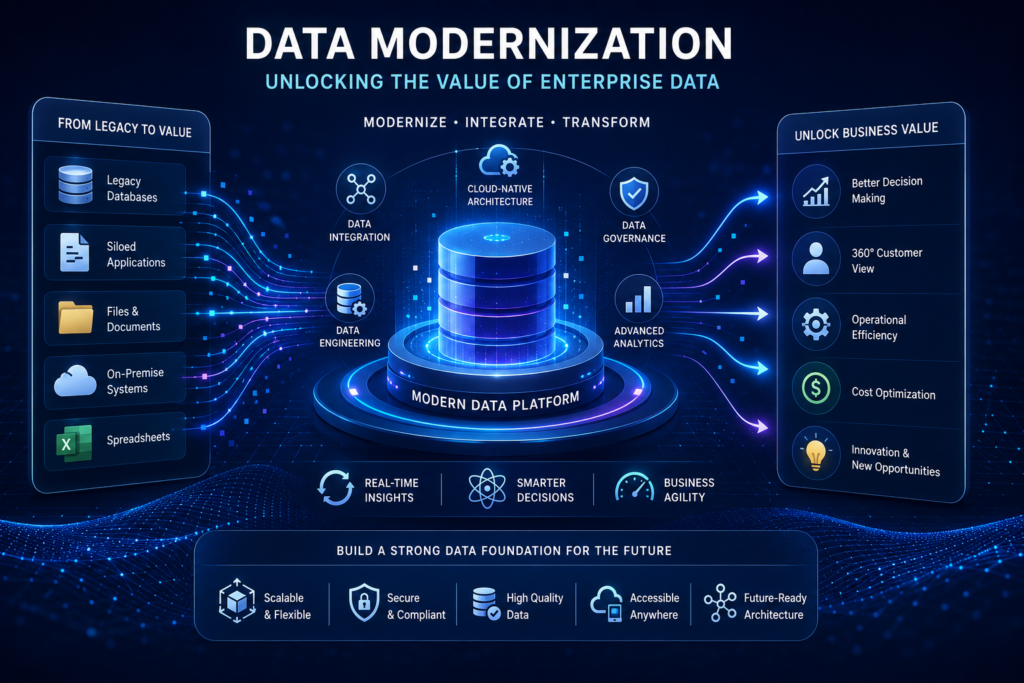
Rather than simply storing data, modern enterprises aim to create unified data ecosystems where information flows seamlessly across departments, applications, and cloud platforms.
Benefits of Data Modernization
- Better business intelligence
- Faster decision-making
- Improved data quality
- Enhanced customer insights
- Increased operational efficiency
- AI-ready data architecture
- Simplified regulatory compliance
Modern data platforms also support advanced technologies such as machine learning, predictive analytics, and enterprise AI, enabling organizations to generate actionable insights from massive volumes of structured and unstructured data.
Companies that modernize their data infrastructure are better equipped to respond quickly to market changes and customer needs.
8. AI-Assisted Software Development Life Cycle (SDLC) with Verification
Software development is becoming increasingly intelligent. In 2026, AI is transforming every phase of the Software Development Life Cycle (SDLC), from requirements gathering to deployment and maintenance.
AI-powered development tools can now:
- Generate code
- Detect bugs
- Review code quality
- Recommend improvements
- Automate documentation
- Create test cases
- Predict software defects
- Optimize application performance
However, AI-generated code must always be validated through verification processes to ensure accuracy, security, compliance, and maintainability.
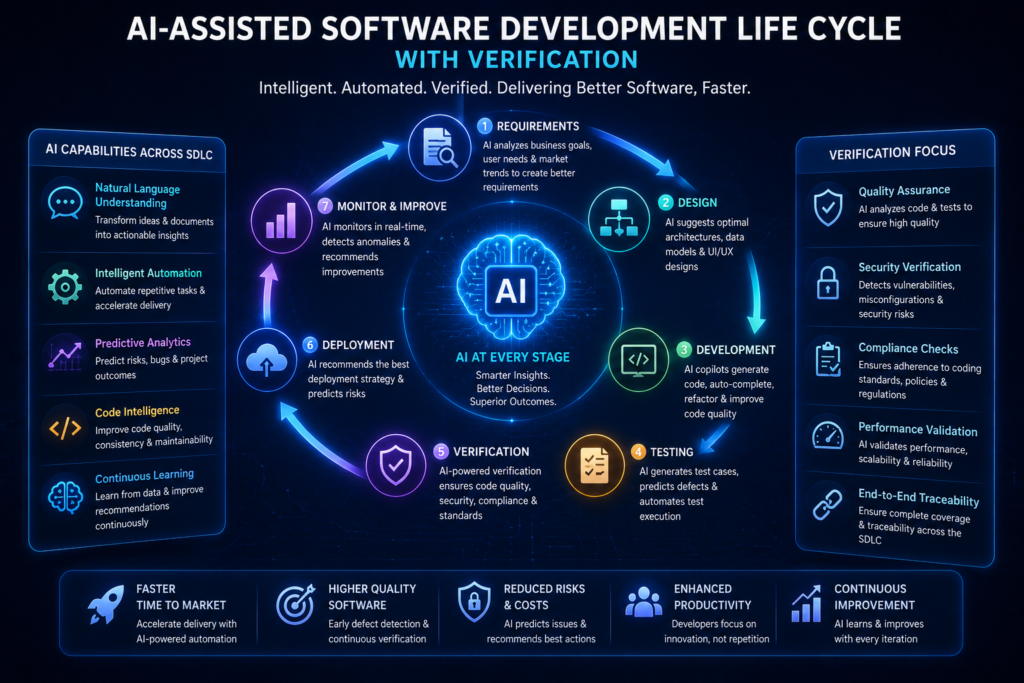
This trend is giving rise to AI-Assisted SDLC with Verification, where AI accelerates software development while experienced engineers validate outputs before deployment.
Advantages for Businesses
Organizations adopting AI-assisted SDLC experience:
- Faster development cycles
- Higher software quality
- Reduced development costs
- Improved developer productivity
- Faster time-to-market
- Stronger application security
Rather than replacing software engineers, AI serves as an intelligent development assistant that enables teams to focus on innovation and complex problem-solving.
Businesses investing in Digital Enterprise Transformation often integrate AI-assisted development practices to modernize application delivery and improve software reliability.
9. ICT Modernization
Information and Communication Technology (ICT) remains the backbone of enterprise operations. However, many organizations continue to rely on aging infrastructure that limits productivity, security, and scalability.
ICT Modernization involves upgrading enterprise technology environments by replacing legacy infrastructure with intelligent, cloud-enabled, and highly secure digital platforms.
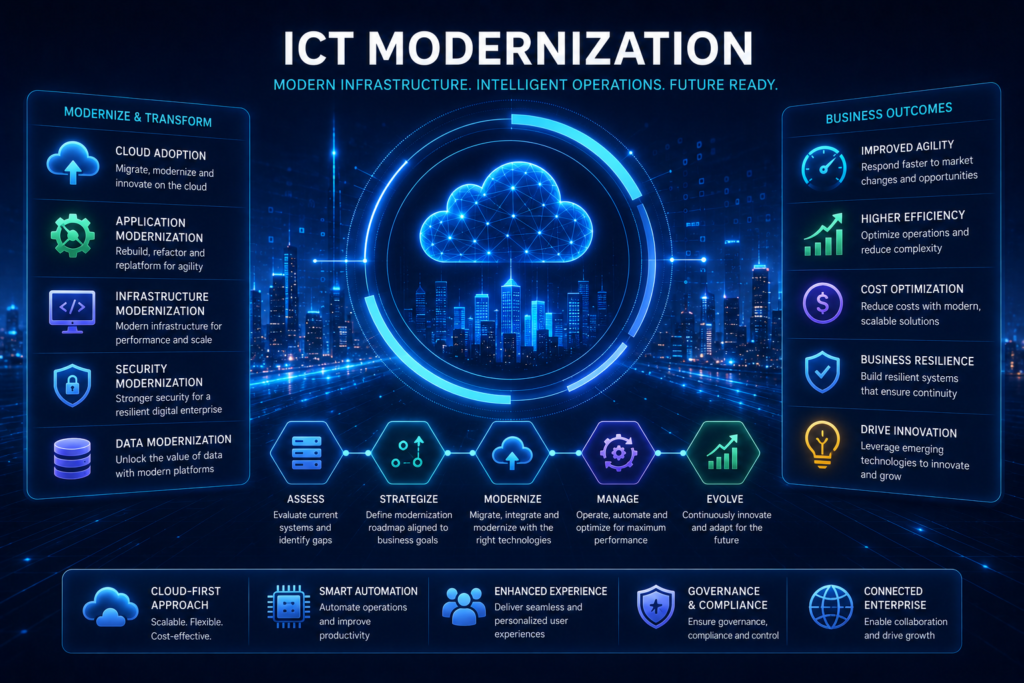
This includes modernizing:
- Enterprise networks
- Communication systems
- Data centers
- Collaboration platforms
- IT infrastructure
- Cloud environments
- Security architecture
Modern ICT environments support remote work, hybrid workplaces, digital collaboration, and seamless integration across business applications.
Why ICT Modernization Matters
Organizations that modernize their ICT infrastructure benefit from:
- Higher productivity
- Reduced operational costs
- Improved cybersecurity
- Better customer experiences
- Greater business agility
- Enhanced digital collaboration
- Increased infrastructure scalability
ICT modernization also provides the foundation required for adopting AI, automation, cloud computing, and other emerging technologies.
How These Technology Trends Are Shaping the Future
The technologies discussed in this article are not isolated innovations-they are interconnected components of the modern digital enterprise.
For example:
- Agentic AI automates business decisions.
- Multimodal AI enhances customer interactions.
- Enterprise RAG improves organizational knowledge sharing.
- Cloud 3.0 provides scalable infrastructure.
- Data Modernization powers analytics and AI.
- AI-assisted SDLC accelerates software delivery.
- Cyber Resilience protects digital assets.
- ICT Modernization strengthens enterprise operations.
Organizations that successfully integrate these technologies will become more agile, data-driven, secure, and competitive in the years ahead.
How ParamInfo Helps Businesses Embrace Emerging Technologies
Technology adoption requires more than implementing new tools-it requires strategic planning, industry expertise, and continuous innovation.
At ParamInfo, we help businesses modernize their technology ecosystem through end-to-end digital transformation services.
Our expertise includes:
- Enterprise Application Development
- Infrastructure Modernization
- Cybersecurity Services
- Data & Analytics Solutions
- Quality Engineering & Testing
Whether you’re modernizing legacy systems, implementing AI solutions, migrating to the cloud, or improving enterprise security, our experts help you accelerate innovation while minimizing operational risks.
The rapid evolution of technology in 2026 presents both opportunities and challenges for businesses. From Agentic AI and Multimodal AI to Cloud 3.0, Enterprise RAG, Data Modernization, and ICT Modernization, these innovations are reshaping how organizations operate, compete, and deliver value.
Businesses that proactively adopt these technologies can streamline operations, enhance customer experiences, improve cybersecurity, and unlock new growth opportunities. However, successful adoption requires a clear digital strategy, robust IT infrastructure, and the right technology partner.
At ParamInfo, we empower organizations to navigate this transformation with confidence. Through our expertise in AI, cloud, digital transformation, and managed IT services, we help businesses build intelligent, secure, and future-ready technology ecosystems that drive long-term success.
The future belongs to organizations that innovate today. By embracing these top technology trends in 2026, your business can stay ahead of the competition and thrive in an increasingly digital world.
Frequently Asked Questions (FAQs)
1. What are the top technology trends in 2026?
The top technology trends include Agentic AI, Multimodal AI, Enterprise RAG, AI Governance, Cyber Resilience, Cloud 3.0, Data Modernization, AI-assisted SDLC, and ICT Modernization.
2. Why are emerging technologies important for businesses?
Emerging technologies help businesses improve efficiency, enhance customer experiences, strengthen cybersecurity, reduce operational costs, and drive innovation.
3. What is Agentic AI?
Agentic AI refers to autonomous AI systems capable of making decisions, planning workflows, and executing tasks with minimal human intervention.
4. How does Multimodal AI benefit organizations?
Multimodal AI processes multiple forms of data-such as text, images, audio, and video—to provide more accurate insights and improve customer interactions.
5. What is Enterprise RAG?
Enterprise Retrieval-Augmented Generation (RAG) combines AI with an organization’s internal knowledge base to deliver accurate, context-aware responses using trusted company data.
6. What is Cloud 3.0?
Cloud 3.0 is the next generation of cloud computing that integrates AI, automation, hybrid cloud, edge computing, and advanced security to optimize cloud operations.
7. Why is Data Modernization important?
Data Modernization enables organizations to improve data quality, support AI initiatives, gain real-time insights, and make faster business decisions.
8. How is AI transforming software development?
AI assists developers by generating code, automating testing, identifying bugs, improving documentation, and accelerating software delivery while maintaining quality through verification.
9. What is ICT Modernization?
ICT Modernization involves upgrading enterprise IT infrastructure, communication systems, and networks to improve security, collaboration, and business agility.
10. How can businesses prepare for future technology trends?
Organizations should invest in digital transformation, cloud adoption, cybersecurity, AI, workforce upskilling, and scalable IT infrastructure to remain competitive.
11. Which industries benefit the most from these technology trends?
Industries including healthcare, banking, retail, manufacturing, telecommunications, logistics, education, and government can significantly benefit from these emerging technologies.
12. How can ParamInfo help businesses adopt emerging technologies?
ParamInfo provides AI solutions, cloud migration, managed IT services, digital enterprise transformation, cybersecurity, and enterprise technology consulting to help organizations successfully implement modern technologies.
