

Choosing an ERP platform is one of the most consequential technology decisions a Dubai business will make. Get it right and you gain a unified, scalable backbone for operations, finance, and customer management. Get it wrong and you spend years working around a system that was never built for your business. SAP, Oracle, and Salesforce are the three names that come up most in boardrooms across the UAE, and each has a genuinely different value proposition.
This comparison is written for IT directors, business owners, and operations heads evaluating ERP platforms for UAE and Gulf enterprise environments. If you want hands-on guidance through the selection process, ParamInfo’s digital transformation advisory team works with businesses across Dubai and the broader Gulf region to match the right platform to the right organisation.
What Makes ERP Selection Difficult in the UAE?
The UAE enterprise market has a few characteristics that make ERP selection more complex than in many other markets.
- Regulatory environment: VAT compliance, UAE Data Protection Law requirements, and sector-specific regulations in banking, healthcare, and government mean your ERP must handle local compliance out of the box or through certified localisation.
- Multi-entity operations: Many Dubai businesses operate across the GCC, which means the ERP needs to support multiple currencies, tax regimes, and reporting standards simultaneously.
- Arabic language and localisation: Enterprise systems that lack proper Arabic support create operational friction in bilingual environments.
- Integration with government systems: Customs, tax authority integrations, and labour ministry reporting requirements vary across the region.
The right platform is not simply the most feature-rich one. It is the one that fits your industry, your team’s capabilities, and your growth trajectory across the next five to seven years.
SAP: The Enterprise Standard for Complex Operations
SAP is the dominant choice for large enterprises with complex, process-heavy operations. It is particularly strong in manufacturing, oil and gas, logistics, and public sector environments, all of which have significant presence in the UAE and wider Gulf.
Where SAP excels
- End-to-end ERP coverage: finance, procurement, supply chain, HR, and manufacturing in a single integrated suite.
- Deep industry-specific modules built for sectors like energy, construction, and retail.
- Strong UAE and GCC localisation including VAT compliance, Arabic language support, and Wage Protection System (WPS) integration.
- Proven scalability for enterprises running hundreds of entities across multiple countries.
- Robust reporting and analytics with real-time data across all business units.
Where SAP requires careful consideration
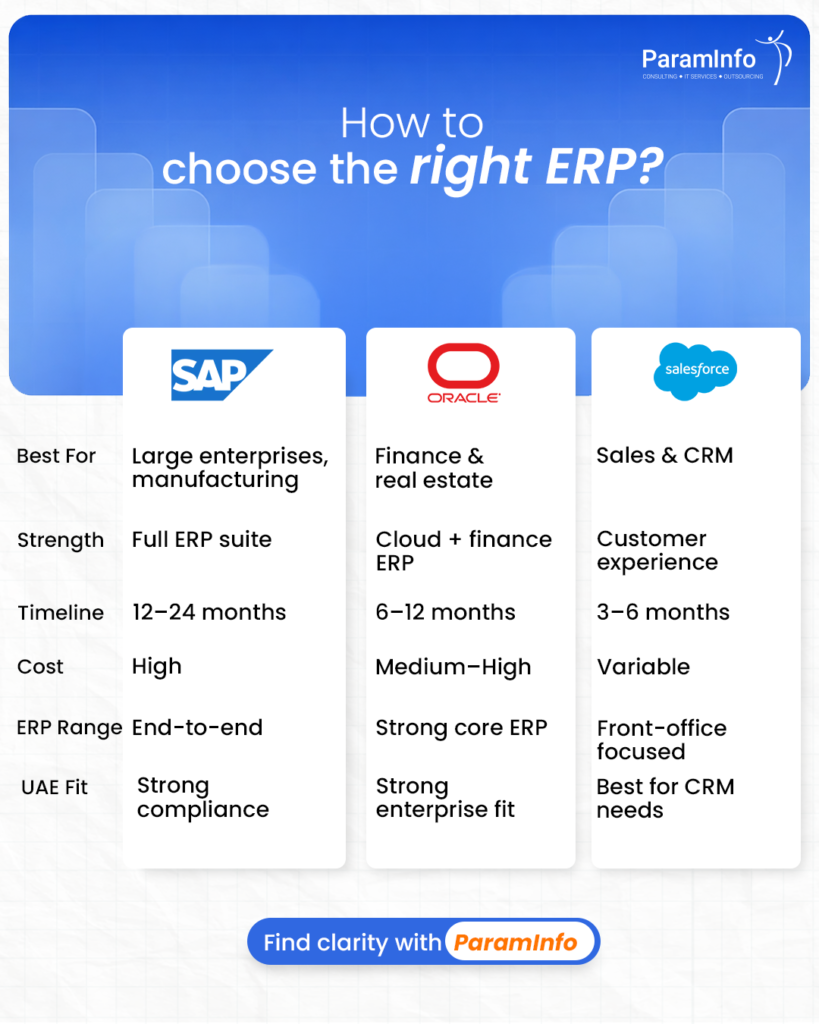
- Implementation timelines are typically longer, often 12 to 24 months for full enterprise deployments.
- Total cost of ownership is higher, particularly for smaller organisations that do not need the full suite.
- Requires dedicated internal expertise or a specialist implementation partner to configure and maintain effectively.
For UAE businesses in manufacturing, logistics, or oil and gas, SAP’s depth is hard to match. ParamInfo’s SAP consulting services cover end-to-end implementation, customisation, and ongoing support for Gulf region deployments.
Oracle: Integrated Finance and Cloud Flexibility
Oracle sits between SAP’s depth and Salesforce’s agility. It is a strong choice for finance-led organisations, businesses with complex ERP and database requirements, and enterprises that want a cloud-first architecture without sacrificing functional depth.
Where Oracle excels
- Oracle Fusion Cloud ERP is one of the strongest cloud-native options for enterprise finance management.
- Tight integration between ERP, EPM (enterprise performance management), and supply chain modules.
- Strong capabilities for real estate, financial services, and professional services firms, all well-represented in Dubai.
- AI and machine learning embedded across modules for predictive analytics and automation.
- Competitive licensing model for mid-market enterprises compared to SAP at equivalent scale.
Where Oracle requires careful consideration
- Oracle’s broad product portfolio can make the right configuration harder to identify without specialist guidance.
- Integration with non-Oracle systems can require additional middleware investment.
- Like SAP, full implementations require experienced consulting partners rather than in-house configuration alone.
Oracle is a particularly strong fit for UAE enterprises in financial services, real estate, and professional services. ParamInfo’s Oracle consulting services help Dubai businesses navigate platform selection, configuration, and post-go-live optimisation.
Salesforce: CRM-First with Growing ERP Capabilities
Salesforce is not a traditional ERP in the same sense as SAP or Oracle. It started as a CRM platform and has expanded significantly through acquisitions and its own product development. For businesses where customer relationship management, sales pipeline, and service operations are the core priority, Salesforce is the most capable platform available.
Where Salesforce excels
- Best-in-class CRM: sales force automation, pipeline management, and customer service are unmatched in the market.
- Highly configurable and relatively fast to implement compared to SAP or Oracle full-suite deployments.
- AppExchange ecosystem provides thousands of pre-built integrations and industry-specific extensions.
- Strong fit for retail, media, hospitality, and professional services businesses where customer experience is the competitive differentiator.
- Native integration with customer experience tools, which aligns well with ParamInfo’s CX consulting services for UAE businesses focused on customer-centric transformation.
Where Salesforce requires careful consideration
- Back-office ERP functions such as manufacturing, supply chain, and complex financial consolidation are weaker compared to SAP and Oracle.
- Licensing costs scale quickly with user count and add-on products.
- Businesses that need a unified back-office and front-office platform in a single system will often need to integrate Salesforce with a separate ERP, adding complexity.
For Dubai businesses in retail, hospitality, or financial services where customer engagement is the primary driver, Salesforce is a strong contender. ParamInfo’s Salesforce consulting services help UAE organisations implement, customise, and scale Salesforce across their operations.
Head-to-Head: SAP vs Oracle vs Salesforce for Dubai Businesses
By industry fit
- Manufacturing, logistics, oil and gas, construction: SAP is the strongest choice in most cases.
- Financial services, real estate, professional services: Oracle Fusion Cloud ERP is a leading option.
- Retail, hospitality, media, customer-facing services: Salesforce delivers the best front-office capability.
- Government and public sector: SAP and Oracle both have strong public sector credentials in the Gulf.
By business size
- Large enterprise (500+ employees, multi-entity): SAP or Oracle, both support the complexity required.
- Mid-market (100 to 500 employees): Oracle Fusion mid-market or Salesforce with integrated ERP is worth evaluating.
- SME with growth ambition: Salesforce for customer-facing operations; evaluate SAP Business One or Oracle NetSuite for back-office.
By implementation timeline
- Fastest to value: Salesforce, typically 3 to 6 months for core CRM deployment.
- Mid-range: Oracle Fusion, typically 6 to 12 months for finance-led deployments.
- Longest: SAP full-suite, typically 12 to 24 months for enterprise deployments.
By total cost of ownership
- Highest TCO over 5 years: SAP full-suite enterprise, though the ROI is strong for complex operations.
- Mid-range: Oracle Fusion, particularly for finance-first deployments.
- Variable: Salesforce scales with user count and modules; costs can rise quickly for large teams.
What UAE Businesses Often Get Wrong in ERP Selection
After working with enterprise clients across Dubai and the Gulf for over 16 years, ParamInfo has seen a consistent set of mistakes in ERP selection.
- Choosing based on brand recognition rather than functional fit. The most-used platform globally is not always the best fit for your specific operations.
- Underestimating implementation complexity. All three platforms require specialist implementation partners for enterprise deployments. Internal IT teams rarely have the experience to handle it without support.
- Ignoring total cost of ownership. Licence cost is only one component. Training, customisation, integration, and ongoing support are often larger line items over a five-year period.
- Not accounting for GCC-specific requirements upfront. VAT, WPS, Arabic language support, and local compliance should be validated before signing any contract.
- Skipping the integration assessment. Most UAE enterprises have existing systems that the new ERP needs to connect with. ParamInfo’s system integration services ensure new ERP platforms connect cleanly to your existing application landscape.
How to Make the Right Decision for Your Dubai Business
There is no universally correct answer. The right ERP platform is the one that fits your industry, your current operational complexity, your budget envelope, and your internal capability to manage the implementation and post-go-live operations.
A structured evaluation process typically covers:
- Business requirements mapping: what processes does the ERP need to support, and which are non-negotiable.
- Vendor demonstration and reference checks with UAE or GCC customers in your industry.
- Total cost of ownership modelling across a five-year horizon.
- Implementation partner assessment: who will actually deliver the project, not just sell the licence.
- Post-go-live support model: internal team readiness, managed services, or a hybrid approach.
If your team needs structured support through this process, ParamInfo’s Microsoft services and enterprise consulting capabilities extend across the full ERP landscape to help Dubai businesses make confident, well-informed platform decisions.
The ParamInfo Advantage for UAE ERP Projects
ParamInfo has been delivering enterprise technology projects across Dubai and the Gulf for over 16 years. With 600 technical experts, 100+ enterprise clients, and partnerships with SAP, Oracle, Salesforce, and Microsoft, we bring genuine multi-platform expertise rather than a single-vendor bias. Whether you are starting an ERP evaluation, mid-way through an implementation that has stalled, or looking to optimise a platform you already own, our SAP consulting, Oracle consulting, and Salesforce consulting teams are available to support your project from day one. Contact us at info@paraminfo.com or call our Dubai office at +971 45516694.
Frequently Asked Questions (FAQ)
Which ERP is best for a manufacturing company in Dubai?
SAP is typically the strongest choice for manufacturing businesses in Dubai and the wider UAE. Its industry-specific modules for production planning, materials management, and supply chain are deeply developed and widely used across Gulf manufacturing and industrial operations. SAP also has strong UAE localisation including VAT compliance and Arabic language support.
How much does ERP implementation cost in the UAE?
ERP implementation costs in the UAE vary significantly based on platform, scope, and business size. A mid-market Salesforce CRM deployment might range from AED 150,000 to AED 500,000. A full SAP or Oracle enterprise deployment for a large organisation can run from AED 1 million to AED 10 million or more, including licensing, implementation, data migration, training, and first-year support. Total cost of ownership over five years is the more meaningful figure to evaluate.
Can Salesforce replace SAP or Oracle for a UAE enterprise?
Not entirely in most cases. Salesforce excels at customer-facing operations: sales, marketing, and service. However, back-office functions such as complex financial consolidation, manufacturing, and supply chain management are stronger in SAP and Oracle. Many UAE enterprises run Salesforce alongside SAP or Oracle, using integration to connect front-office and back-office data.
How long does ERP implementation take in the UAE?
Implementation timelines vary by platform and scope. A core Salesforce CRM deployment typically takes 3 to 6 months. An Oracle Fusion finance deployment for a mid-sized enterprise usually takes 6 to 12 months. A full SAP enterprise suite implementation at a large organisation is typically 12 to 24 months. Phased approaches, where the most critical modules go live first, are increasingly common for managing risk and delivering faster initial value.
Do SAP and Oracle support UAE VAT and local compliance requirements?
Yes, both SAP and Oracle have certified UAE localisation packages that cover VAT calculation and reporting, integration with the Federal Tax Authority, Arabic language support, and Wage Protection System compliance. It is important to verify that the specific version and modules you are implementing include these features, as localisation quality can vary between product lines within each vendor’s portfolio.
